

Get Your Free Estimate Now
"*" indicates required fields









In Ontario, local moves often cost between $800 and $3,000. Long-distance moves often range from $3,500 to $7,500 or more. These numbers are planning ranges, not fixed prices.
Several factors shape the final cost in Ontario. Home size, crew size, truck space, access conditions, packing status, and travel distance all affect the estimate.
For example, a short condo move with elevator limits and long hallway carries can require more labour than a house move with direct driveway access.
This guide explains how movers calculate Ontario moving costs, what changes an estimate, and which fees to confirm before booking.
It also covers Ottawa-specific details such as parking, elevator windows, truck access, and seasonal scheduling.
Reviewed by: Mr. Ajay Paul Singh, Director of Operations (Canada)
Ottawa operational input from: Mr. Amrit Bedi, Operations Manager, Ottawa
This article was reviewed for Ontario moving cost factors, long-distance pricing, crew planning, access conditions, written estimates, and Ottawa-specific moving logistics.
How Moving Estimates Are Calculated in Ontario
Moving costs in Ontario are usually shaped by a few core details: the size of the move, the amount of labour required, the truck space needed, the distance between addresses, and any conditions that affect how quickly the crew can work. Access, stairs, elevators, parking, packing status, and heavy-item handling can all change the final estimate.
For local moves, most companies start with time, crew size, and truck requirements. For longer routes, the estimate may also depend on inventory volume, total travel distance, and the type of pricing model being used.
How to Read an Ontario Moving Quote
Before comparing prices, it helps to understand what kind of quote you are actually getting. Two movers can mention a similar number, but that does not always mean the same services, time assumptions, or conditions are included.

A verbal estimate is only a starting point
A quick number shared over the phone can help with early planning, but it is not enough to rely on by itself. If the mover has not reviewed the inventory, access conditions, distance, and moving date properly, the final cost can change later.
A written estimate should explain what is included
A proper written quote should make it clear what the mover has priced in. That usually includes labour, truck time, travel or mileage, access conditions, furniture handling, and any extra services such as packing or storage. If those details are missing, the quote may look lower than it really is.
A binding-style price matters more on larger or longer moves
For bigger moves, longer routes, or homes with more inventory, a clearer written price becomes even more important. When the move is more complex, small missing details can create bigger pricing gaps later.
What you should confirm before booking
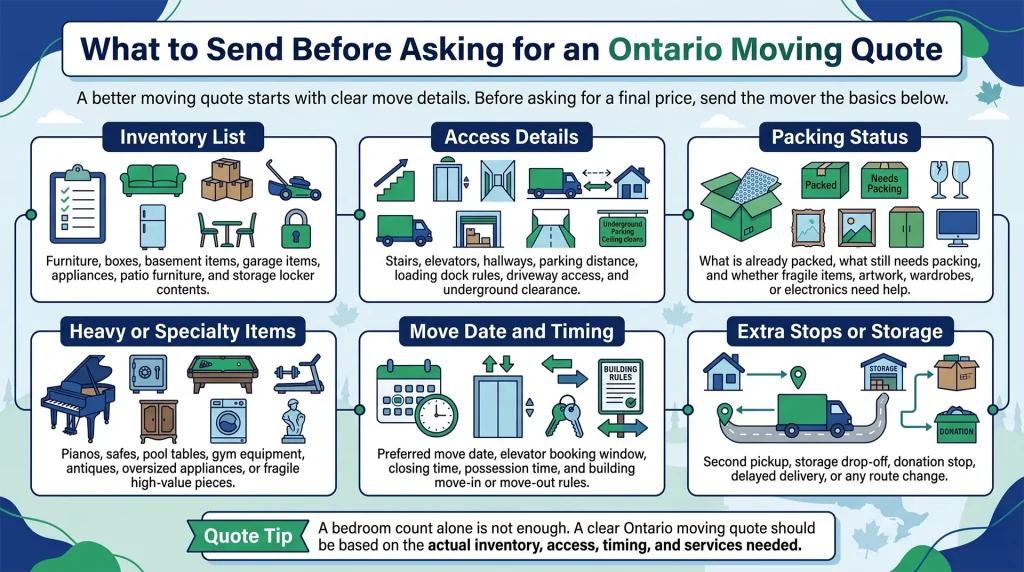
Before accepting any quote, make sure the mover has the right details in writing. That includes the pickup and delivery addresses, home or building type, number of rooms, stairs, elevator access, parking setup, moving date, and any large or fragile items. The clearer these details are, the more reliable the estimate usually becomes.
Why this matters
A moving quote is not only about the price. It is also a check on how carefully the mover has understood the job. When the estimate is clear, the chances of confusion, missed charges, or last-minute surprises usually go down.
Local Moves and Hourly Rates
For many local Ontario moves, pricing starts with an hourly structure based on crew size and truck setup. That hourly rate can be useful for early budgeting, but it does not always show the full cost on its own. The final total still depends on how long the move takes, how much is being moved, and whether access issues slow the job down.
A short move between two nearby homes can still cost more than expected if the crew has to deal with stairs, long hallway carries, tight parking, or elevator delays. On the other hand, a slightly longer drive may stay efficient when the truck can park close and the loading setup is simple.
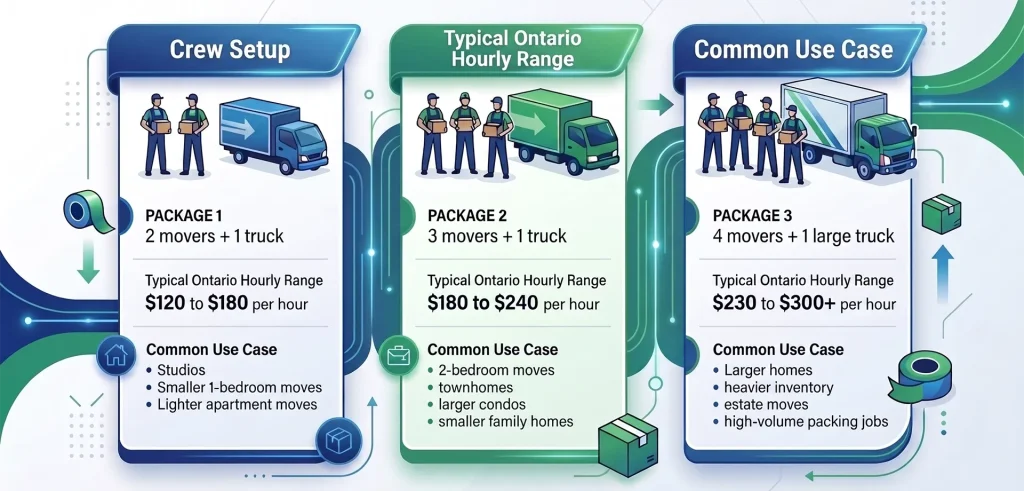
Use these numbers as a starting point. The final price depends on the specific home, access, crew size, packing status, moving date, and any written confirmations.
Pricing Note: The lowest hourly rate does not always guarantee the lowest moving cost. For larger homes, stairs, long carries, heavy furniture, or bigger inventories, a larger crew may finish the job in fewer hours. For example, a 2-person crew at $150 per hour for 9 hours totals $1,350. A 3-person crew at $180 per hour for 6 hours totals $1,080. In that case, the higher hourly rate results in a lower final bill because the crew completes the work faster.
Understanding Long-Distance Moving Pricing in Ontario
Long-distance moving prices in Ontario are usually calculated differently from local hourly moves. Once a move goes beyond the local service area, the estimate is shaped by more than the number of hours the crew spends loading and unloading.
Distance still matters, but it is only one part of the price. The final cost can also depend on how much truck space the shipment needs, how much fuel and travel time are involved, how the crew is scheduled, and how easy or difficult the loading conditions are at both addresses.
Long-Distance Ontario Moves: Planning Beyond Kilometres
A long-distance move is usually planned around the full setup of the job, not only the kilometres between two addresses. The size of the shipment, access at both homes, truck space, loading time, and delivery schedule can all affect how the estimate is prepared.
For example, the moving cost from Toronto to Ottawa is not based only on kilometres. A small, well-packed apartment with easy elevator access may price very differently from a full family home with basement items, garage storage, heavy furniture, and tight loading conditions.
Long-distance pricing may include:
- Route distance and travel time
- Fuel and route planning
- Truck size or shipment space
- Loading and unloading labour
- Crew scheduling and travel time
- Dedicated truck or shared transport setup
- Highway tolls where applicable
- Packing or specialty-item services
- Storage or delayed delivery needs
A dedicated truck may cost more, but it usually gives the move a clearer schedule because the truck is assigned to one shipment. Shared transport may be more flexible in some cases, but delivery timing can depend on route planning and available truck space.
If the route uses Highway 407 or another toll route, ask whether those charges are included in the written quote or billed separately. This is a small detail, but it can still affect how clearly you understand the final price before booking.
Flat Rate vs Hourly Pricing
Hourly pricing usually works better when:
- The move is local and access is simple
- The inventory is clear before moving day
- Packing is already finished
- The truck can park close to the entrance
- There are no major specialty items or long carries
Hourly pricing can still change if the move takes longer than expected. Stairs, elevator delays, long hallways, parking distance, and unfinished packing can all add time.
Flat-rate pricing is usually better for larger Ontario relocations where distance, truck space, labour, fuel, and timing need to be clearly included in writing.

5 Ontario Moving Cost Factors That Can Change Your Final Price
1. Inventory Size and Home Type
The size of the move is one of the biggest factors in the final moving cost. More furniture, boxes, basement items, garage storage, and outdoor pieces usually mean more truck space, more labour time, and more trips between the home and the truck.
A bedroom count can help with early planning, but it does not tell the full story. A lightly furnished 3-bedroom home may cost less to move than a packed 2-bedroom townhome with stairs, storage bins, heavy furniture, and limited parking.
Local moving prices usually start with crew size, hourly rate, minimum booking time, and truck fee. The examples below show how common local moves may be priced before access, inventory, and move-day conditions are fully reviewed.
| Move Type | Typical Crew | Peak-Date Rate | Peak-Date Starting Minimum | Regular-Day Rate |
|---|---|---|---|---|
| Studio apartment | 2 movers | $145/hr | 2-hour minimum + $185 truck fee = from $475 | $129–$139/hr |
| 1-bedroom local move / 2-bedroom condo or townhome | 3 movers | $209/hr | 2-hour minimum + $199 truck fee = from $617 | $180–$199/hr |
| 3-bedroom family home | 4 movers | $239/hr | 2-hour minimum + $249 truck fee = from $727 | $239/hr |
These are starting planning examples, not fixed final prices. A move can cost more when the job takes longer than the minimum booking time or when access, packing, stairs, elevators, parking distance, heavy items, or truck space requirements add more time.
For example, a studio apartment with finished packing and easy truck access may stay closer to the minimum. A 3-bedroom family home with basement storage, garage items, oversized furniture, or a long carry from the driveway will usually need more time and planning.
Biggest Price Changers in Ontario Moving Costs
While every move is different, a few details usually have the biggest effect on the final price.
Inventory size affects how much labour, truck space, and loading time the move needs.
Property access can change the total time. Stairs, elevators, long carries, tight hallways, and limited truck parking can all slow down loading or unloading.
Move date matters because month-end, weekends, summer dates, and student turnover periods can book faster.
Distance affects travel time, fuel, route planning, and crew scheduling, especially when the move goes outside the local area.
Truck space becomes more important when the move includes larger furniture, garage items, basement storage, or multiple rooms of packed boxes.
For most Ontario relocations, the final estimate is shaped by a mix of these details, not by home size or distance alone.
2. Season and Moving Date
The date you choose can change your final moving cost. Movers are usually busier at the beginning and end of each month because leases, closings, elevator bookings, and possession dates often fall on those days.

Mover’s Scheduling Insight: For Ontario moves, midweek and mid-month dates are usually easier to schedule than month-end dates, the 1st and 2nd, weekends, or peak summer dates. When trucks and crews are less booked, pricing is often easier to control.
3. Building Access and Carry Distance
Access can change the final moving cost because it affects how long the crew needs to load and unload.
Movers look beyond the number of rooms and check how far items must be carried, where the truck can park, and whether elevators, stairs, or tight entryways will slow the job down.
Common access issues include:
- Long condo hallways between the unit and loading area
- Elevator booking windows with limited move times
- Underground parking with low clearance for larger moving trucks
- Street parking that keeps the truck far from the entrance
- Multiple flights of stairs or narrow stairwells
- Tight doorways, sharp turns, or older building layouts
A move with simple driveway access may take less time than a move to a smaller condo with elevator limits, long carries, and restricted loading space.
4. Specialty Items and Heavy Pieces
Some items cost more to move because they need extra labour, protection, equipment, or planning.
These pieces may be heavy, fragile, awkward to carry, or harder to move through stairs, elevators, narrow doors, or tight turns.
Specialty moving fees may apply for items such as:
- Upright or grand pianos
- Large safes or commercial fireproof cabinets
- Slate pool tables that need partial disassembly
- Fine art, statues, antiques, or fragile family pieces
- Gym equipment, oversized appliances, or unusually heavy furniture
These items should be mentioned before the estimate is finalized. A mover may need a larger crew, special dollies, extra padding, disassembly time, or a separate specialty plan.
5. Packing Services and Moving Materials
Packing can change the final moving cost because it affects labour time, material use, and the condition of items before the crew arrives.
A customer-packed move may cost less upfront, but poorly packed boxes slow the job down and increase the risk of damage.
Professional packing services may add cost, but they can be useful for kitchens, fragile items, artwork, wardrobes, glassware, electronics, and large homes with limited time before moving day.
Packing-related costs may include:
- Moving boxes
- Wardrobe cartons
- Dish packs
- Wrapping paper
- Bubble wrap or packing foam
- Tape and labels
- Mattress bags
- Custom crating for fragile or high-value items
Before looking at regional examples, it helps to remember that Ontario moving costs can vary by market and route.
A downtown Toronto condo, an Ottawa government relocation, a Hamilton family home, and a smaller-city move in Eastern Ontario may all involve different access, scheduling, and travel conditions.
How Moving Costs Change Across Ontario Regions
Moving costs can change a lot across Ontario because the same home size does not create the same moving conditions in every region. A downtown Toronto condo, an Ottawa government relocation, a Hamilton family home, and a Kitchener-to-London suburban move can all look very different once access, scheduling, truck placement, and travel distance are reviewed.
Toronto and GTA Condo Moves
In Toronto and the GTA, condo and apartment moves often depend on elevator booking windows, loading dock rules, underground parking clearance, and long hallway carries. A smaller unit can still take more labour when the building has strict time limits or limited truck access. For these moves, quote accuracy usually depends on elevator booking length, loading dock access, hallway distance, and whether the truck can legally stop close to the building.
Ottawa and Eastern Ontario Access-Heavy Moves
Ottawa and Eastern Ontario moves can price differently because the region combines older neighbourhood layouts, suburban homes, government relocations, student rental turnover, and seasonal scheduling pressure. For Ottawa-area moves, the estimate should review truck placement, stairs, older layouts, government or student move dates, and whether parking or elevator timing could slow the job.
In downtown areas such as Centretown, Sandy Hill, The Glebe, Lowertown, and Westboro, truck placement, long carry distance, condo rules, stairs, and tighter building layouts can all add labour time. Government, military, and student move periods can also affect truck availability and booking windows.
Hamilton and Niagara Family-Home Routes
In Hamilton and Niagara, moving costs often change when the job involves larger detached homes, basement storage, garages, and longer suburban loading time. These routes may look simple on paper, but family-home volume and driveway-to-truck setup can change labour and truck requirements quickly. For Hamilton and Niagara routes, the biggest quote changes often come from basement contents, garage storage, outdoor items, driveway setup, and larger family-home inventory.
Kitchener, Waterloo, and London Suburban-Tech Corridor Moves
In Kitchener, Waterloo, and London, moving costs often depend on a mix of condo, townhome, and suburban-home logistics. Home offices, electronics, hybrid-work setups, and longer regional driving time can all affect how the move is priced and how the crew and truck are planned. For these routes, it helps to mention home office equipment, electronics, townhouse access, condo rules, and any longer regional travel time before the estimate is finalized.
Planning an Ontario Move? Compare the Details Before You Book
Before requesting estimates, compare route details, inventory, access conditions, moving date, and any specialty items so the price can be reviewed more accurately in writing.
Red Flags to Watch for Before Accepting an Ontario Moving Estimate
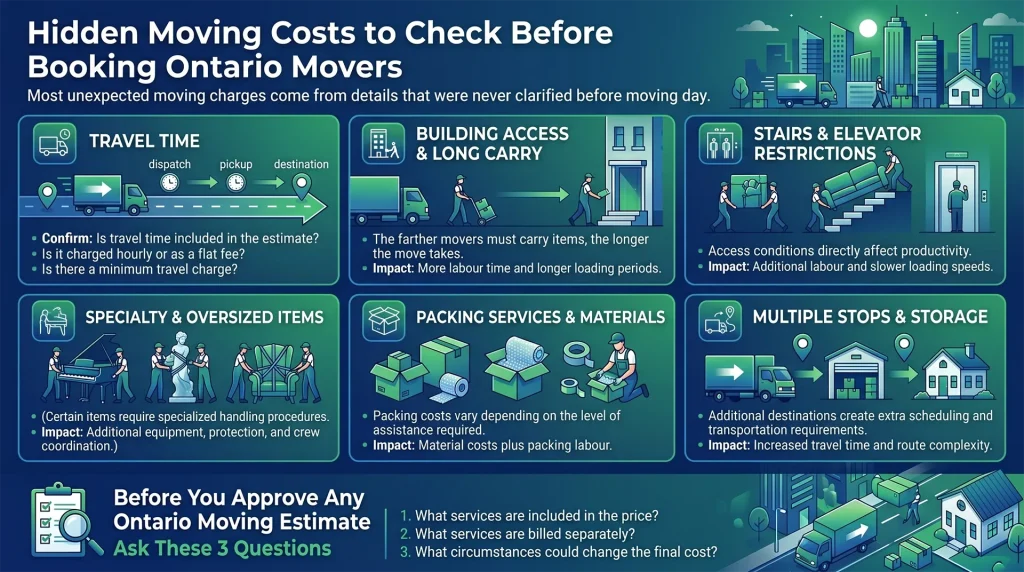
A moving estimate should explain the job, not just show a low number. Before booking, check what was reviewed, what is included, and what could change the final price.
1. Price Much Lower Than Other Quotes
If most movers estimate your move between $1,500 and $2,000, but one company offers $800, ask what is missing.
- A very low price may leave out:
- Basement or garage items
- Stairs or elevator timing
- Parking distance
- Packing needs
- Heavy furniture
- Travel time
- Truck space
A lower estimate is not always wrong, but it should be clearly explained.
2. No Inventory or Access Review
Bedroom count is not enough. A 3-bedroom home with a basement, garage, patio furniture, storage bins, and heavy pieces is a different job from a lightly furnished 3-bedroom home.
Before accepting the estimate, the mover should ask about inventory, stairs, elevators, parking, storage areas, packing status, and any specialty items.
3. Verbal Price With No Written Details
Phone quotes can help with early planning, but the booking should be confirmed in writing.
The written estimate should show the crew, truck needs, rate structure, travel time, packing materials, specialty fees, payment terms, and cancellation policy.
If an important cost or promise is not written down, do not rely on it.
Ontario Mover Credentials and Consumer Protection Checks
Before accepting a moving estimate, check more than the price.
A proper estimate should show the company’s contact details, services included, itemized pricing, payment terms, and the dates of service.
When booking, ask the mover to explain the differences among cargo protection, basic liability, insurance, and worker safety coverage.
These do not cover the same things. Belonging protection covers items being moved, while worker safety coverage covers the crew on the job.
Before booking, confirm:
- Business name, address, and phone number
- Written estimate with clear pricing
- Insurance or cargo protection details
- WSIB or worker safety coverage where applicable
- Payment terms and deposit policy
- Damage claim process
- Cancellation or rescheduling policy
A reliable Ontario mover should be able to explain the estimate, protection coverage, worker safety coverage, payment terms, and claims process before the move is confirmed.
Ontario customers can also do a few simple checks before booking. The Ontario government recommends getting written estimates before signing with a mover, and the Ontario Business Registry can help customers verify basic business information. WSIB clearance tools can also help confirm whether a business has workplace coverage details available where applicable.
2026 Ontario Moving Cost Examples Including Ottawa and GTA Routes
Moving prices are easier to understand when the details are shown together.
The examples below show how Ottawa, Eastern Ontario, and GTA-to-Ottawa moves can fall into different planning ranges based on access, inventory, distance, and timing.
Use these as planning examples, not fixed prices. A mover should confirm the final price in writing after reviewing the actual move details.
Scenario 1: Local Ottawa Condo Move
| Detail | Example |
|---|---|
| Move profile | 1-bedroom condo |
| Route | Centretown to Westboro |
| Main cost factors | Elevator bookings at both buildings, downtown loading access, hallway carry distance, mid-week booking |
| Crew setup | 2 movers + 1 moving truck |
| Estimated 2026 planning range | $700 to $1,300 |
What This Price Range Really Means
This move may stay closer to the lower end when:
- Elevator access is booked
- Packing is finished
- Parking is close to the building
- The price can move higher when:
- Elevator windows are short
- Parking is limited
- Hallway carries are long
For local Ottawa condo moves, elevator timing and truck access usually make the biggest difference.
A condo move with a small inventory can still take longer when the crew has to work around parking limits, long hallways, or tight elevator windows.
Scenario 2: Suburban Family Home Move
| Detail | Example |
|---|---|
| Move profile | 3-bedroom detached home with finished basement |
| Route | Barrhaven to Orléans |
| Main cost factors | Larger inventory, basement furniture, patio set, driveway access, peak summer weekend booking |
| Crew setup | 3 movers + 1 large moving truck |
| Estimated 2026 planning range | $1,500 to $3,200 |
What This Price Range Really Means
This move may stay closer to the lower end when:
- The driveway is clear
- Packing is finished
- Main furniture is ready to move
The price can move higher when:
- Basement or garage items are included
- Patio furniture needs moving
- The move is booked near month-end or on a summer weekend
For family homes, prices typically fluctuate with inventory volume. Basement contents, garage storage, outdoor furniture, and larger furniture pieces can increase loading time and truck space requirements, even for local routes.
Not sure whether your home needs three, four or five movers? Read our guide to choosing the right crew size for a three- or four-bedroom house.
Scenario 3: GTA to Ottawa Long Distance Move
| Detail | Example |
|---|---|
| Move profile | 3-bedroom home |
| Route | Mississauga to Ottawa |
| Main cost factors | Long-distance transport, truck space, fuel, loading time, unloading time, route planning, possible tolls |
| Crew setup | Loading crew, transport truck, and unloading crew depending on the delivery plan |
| Estimated 2026 planning range | $3,500 to $7,500+ |
What This Price Range Really Means
This move may stay closer to the lower end when:
- The inventory is lighter
- Packing is complete
- Access is simple at both homes
The price can move higher when:
- The home has a larger inventory
- More truck space is needed
- Packing services are added
A GTA-to-Ottawa moving estimate depends on more than just distance.
For a dedicated route like Toronto to Ottawa, the estimate should account for truck space, inventory size, loading and unloading times, fuel, tolls, access at both locations, and delivery timing.
Estimate Comparison Note: In Ontario, moving costs usually rise when a job needs more crew time, more truck space, longer travel, difficult parking, stairs, elevators, extra stops, or tighter scheduling. When comparing movers, ask each company to provide written pricing for the same inventory, access details, travel time, specialty items, and any possible extra charges so the estimates can be compared fairly.
Scenario 4: Toronto Condo to Hamilton Regional Move
| Detail | Example |
|---|---|
| Move profile | 2-bedroom condo |
| Route | Downtown Toronto to Hamilton |
| Main cost factors | Elevator booking, condo loading dock access, underground clearance, regional travel time, parking at delivery |
| Crew setup | 2–3 movers + 1 moving truck |
| Estimated 2026 planning range | $1,800 to $3,500 |
What This Price Range Really Means
This move may stay closer to the lower end when elevator access is booked, packing is finished, and both buildings allow close truck access.
The price can move higher when the loading dock is limited, the condo has long hallway carries, the truck cannot use underground access, or the delivery address has stairs or tight street parking.
The Bottom Line on Ontario Moving Estimates
A good Ontario moving estimate should make the expected cost easier to understand rather than leave the customer guessing.
For local Ontario moves, regional relocations, or longer province-wide routes, ask for the estimate details in writing before booking. The most accurate quote usually comes from clear inventory, real access notes, and route-specific planning, not from a rushed price alone.
Ontario Moving Cost FAQs
How much do movers charge per hour in Ontario?
Ontario movers usually charge by crew size, truck size, inventory, and property access. Smaller moves may use 2 movers and 1 truck, while larger homes may need 3 or 4 movers. Always confirm travel time, stairs, elevator access, packing needs, and extra charges in writing.
When is the cheapest time to move in Ontario?
The cheapest time to move in Ontario is usually mid-week, mid-month, and outside the peak summer season. January to March can be easier to schedule. Month-end dates, the 1st and 2nd, weekends, and summer moves often book faster and may cost more.
Do movers charge extra for pianos or safes?
Yes, pianos, safes, pool tables, and other heavy items may cost extra because they need more labour, equipment, protection, and planning. Tell the mover before booking so the estimate includes the right crew, access check, tools, and specialty handling.
Do movers charge travel time in Ontario?
Yes, many Ontario movers charge travel time for local moves. It may cover dispatch to pickup, travel between addresses, and return travel after delivery. Some companies use a flat fee, while others charge by zone or distance. Always confirm how the travel time is shown on the written estimate.

Testimonials

Hardworking, focussed and polite. What surprised me was their care and attention detail, almost as if they were moving their own possessions. Thank you for your incredible service.
Contact Us

How It Works
Quality Services and
the Highest Level of Professionalism

Contact our team
Reach out to Professional Movers Ottawa via phone or e-mail


Get a free estimate
Consult with our agents on additional services you may need


Organize your move with ease
Let us guide you through a smooth moving process
