

Get Your Free Estimate Now
"*" indicates required fields









A large home does not always need a two-day move. Move planning should start with one practical question: can the packing, loading, travel, unloading and basic setup fit into the hours you actually have? Two homes with the same number of bedrooms can still need very different schedules because the amount of furniture, property layout and access conditions may not be the same. This guide helps Ottawa families work out whether a same-day move is realistic or whether splitting the job into two stages makes more sense.
Quick Answer: Which Schedule Fits a Large Home Move?
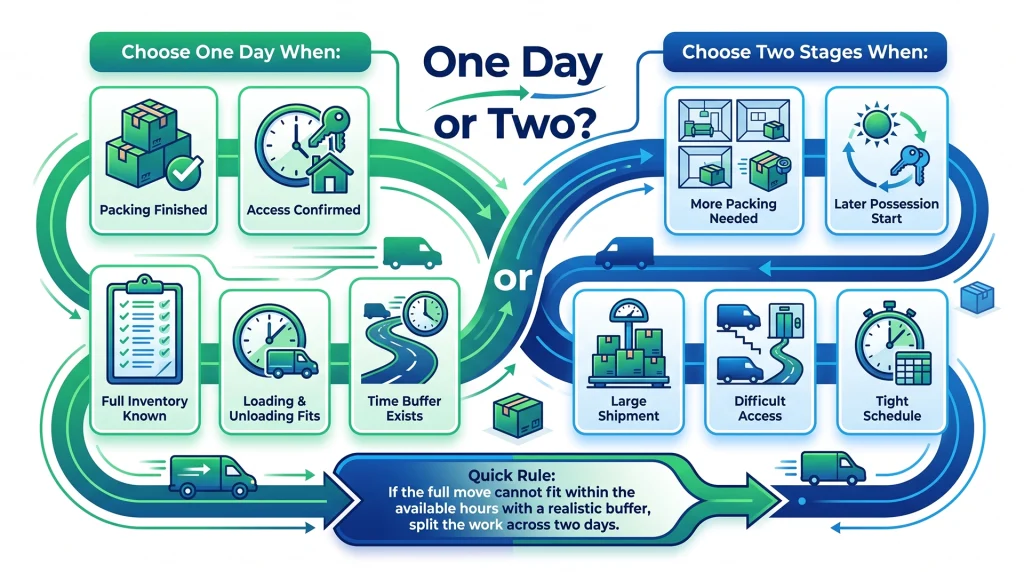
Use one day when loading, travel, unloading, and essential setup fit comfortably within the available hours. Use two days when packing, staged loading, or delayed delivery needs a separate period.
Same-Day vs Two-Stage Move at a Glance
| Comparison | Same-Day Move | Two-Stage Move |
|---|---|---|
| Best suited for | A packed home with confirmed access and enough working hours | Moves needing separate packing, staged loading, or later delivery |
| Main advantage | Loading and delivery are completed during one booking | The workload is divided between two clear stages |
| Main scheduling risk | The day may run late if loading or access takes longer than expected | Delivery depends on the agreed second-day timing |
| Costs to compare | Larger crew, extra truck, overtime, or waiting | Second-day labour, extra travel, and overnight holding |
Calculate Whether the Move Can Fit Into One Day
For a large home, move planning should begin with the hours you can actually use.
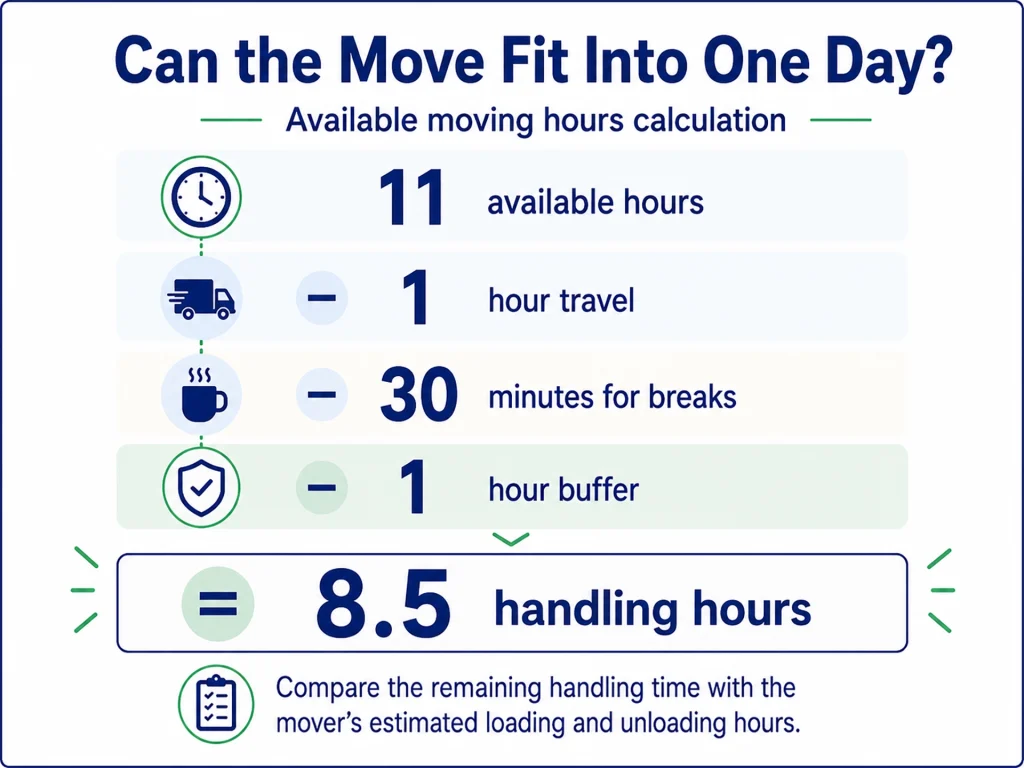
Start with the earliest possible loading time and the latest acceptable finish at the destination. Then allow for travel, planned breaks, building time restrictions, and any period when the new property is unavailable. Keep a separate buffer for unexpected delays.
Compare the remaining hours with the mover’s estimated loading and unloading time.
For example, an 8:00 a.m. to 7:00 p.m. day provides eleven hours. After subtracting one hour of travel, thirty minutes for breaks, and one hour of contingency, eight and a half hours remain for protection, loading, unloading, and setup. If the mover estimates ten handling hours, the job does not fit.
This calculation tests the schedule in real time instead of relying on bedroom count.
Six Factors That Determine the Moving Schedule
Before choosing one day or two, check the six parts of the job that usually take the most time. check how many movers a three- or four-bedroom house may need based on the inventory, access and truck requirements.
Packing Work
Packing is separate from moving labour. Closed, labelled boxes protect furniture and allow loading to begin immediately. Unfinished kitchens, wardrobes, bookshelves, artwork, and fragile collections require sorting, wrapping, and boxing before those areas can be cleared.
Estimate how many rooms still need preparation and how complex those rooms are. One unfinished guest room may add little time. A kitchen, library, and collection of fragile items may require a dedicated packing period.
When several rooms remain unfinished, packing services in Ottawa can be scheduled on a separate preparation day instead of using the truck booking for sorting and boxing.
Possession Timing
The destination cannot be unloaded until it is legally and physically available. Morning possession creates a broad delivery window. A later closing can shift because of paperwork, funding, or key collection.
The important question is what happens if the expected time changes. If possession may be delayed, next-day delivery can avoid paid waiting time, but it may also add overnight holding, extra travel, and second-day labour. Compare the complete cost of both formats before deciding.
When the expected possession time changes after the move has been booked, review what to do when your moving date changes before choosing waiting time, rescheduling or next-day delivery.
Shipment Volume
Volume determines truck space, loading time, and whether another trip may be required. Count every room, storage area, patio, garage, shed, workshop, and seasonal space. Do not rely on the visible living areas alone.
A large shipment may still fit into one day when truck capacity, crew size, access conditions, travel time, and usable working hours all support the schedule. Additional vehicles alone cannot solve a restricted entrance, long carry, or delayed possession. Problems begin when major areas are missing from the estimate, or the truck allocation is based on an incomplete inventory.
Carrying Routes
The route between each item and the truck changes the pace of work. Tight turns, low ceilings, long hallways, steep driveways, distant parking, and several staircases reduce the number of items moved each hour.
Look at the carrying route at both properties. Note any furniture that may be difficult to remove and note where the truck can legally stop. A move may load quickly at the origin but slow down at delivery because the carrying distance is longer or the entrance is harder to use.
Travel Time
Driving time reduces the hours available for handling. Ottawa traffic, bridge crossings, construction, rural roads, and winter conditions can make the journey longer than an ideal map estimate.
Distance becomes more important when the handling workload is already high. A short local trip may leave enough time for a large shipment, while a longer route can make the same amount of work impractical within one date.
Specialty Handling
Pianos, safes, pool tables, oversized sectionals, workshop machines, gym equipment, glass cabinets, and valuable artwork need more than ordinary lifting. Some require dismantling, extra protection, special equipment, or additional movers focused on one piece.
List these items before pricing. The mover can then decide whether they fit into the main sequence or should be handled during a separate stage.
Use these six factors, along with your available moving hours, to determine whether the full job fits into one day.
When the main concern is an oversized sectional, cabinet, bed or another piece that may require dismantling, review our furniture moving services in Ottawa before finalizing the handling time.

How This Kanata-to-Barrhaven Move Was Split Across Two Days
In June 2026, Professional Movers Ottawa handled a five-bedroom detached-home move from Kanata to Barrhaven using five movers and two 26-foot trucks.
The finished basement, double garage, and afternoon possession left too little time to pack and transport on the same date. Packing and dismantling were completed first, followed by loading and delivery the next day. This avoided late-night unloading and an additional truck trip.

How Different Ottawa Home Types Change the Schedule
Compare your property with the examples below to see which layout, access, or storage features could extend the schedule.
Four-Bedroom Suburban Detached Home
Bedroom count can understate the job when the basement and garage are fully furnished. Compare the volume in those areas with the main floors before confirming truck capacity and estimated hours.
Five-Bedroom or Larger Estate Property
The main issue is internal distance. Movers may walk repeatedly between guest rooms, formal living spaces, rear patios, and multiple garage bays before reaching the truck.
Ask how the crew will divide the property into working zones. Parallel loading from different areas can reduce bottlenecks. A poor plan sends everyone through the same doorway and wastes time even when enough movers are present.
Rural Home or Acreage
Outbuildings can turn one household move into several separate loads. Confirm which structures are included and whether driveway conditions require a smaller shuttle vehicle.
Large Central Ottawa Infill Home
Central Ottawa infill homes often lose time at the curb rather than inside the property. Confirm whether legal truck space is available and identify any furniture that must be dismantled before loading begins.
When the entrance is narrow, keep dismantling tools and completed furniture sections away from the main carrying route.
Older Detached or Semi-Detached Home
In older detached and semi-detached homes, the main concern is whether oversized furniture can turn through stairways and landings. Identify pieces that may need partial dismantling or a different exit before lifting begins.
Multi-Level End-Unit Townhome
Use floor-by-floor staging. Clear the upper floor first, then the main level, and finish with the basement. This reduces people crossing on the stairs and prevents boxes from blocking the route.
Keep each floor’s items grouped until that level is ready to load. A defined sequence is more efficient than moving random pieces from several levels at once.
Bungalow With a Finished Lower Level
A finished lower level can contain as much furniture as the main floor. Its volume, staircase, and heavy equipment may determine whether the job fits within the original schedule.
Long-Occupied Home or Downsizing Move
Sort belongings into six groups before packing: keep, move later, donate, sell, dispose, and give to family. Set a deadline for every undecided item.
Do not leave these choices for moving day. Movers cannot work efficiently while boxes are reopened or furniture destinations are debated. Separating decisions from transport keeps the moving schedule focused on physical work.
Three Scheduling Options for a Large Home Move
Each option divides the work differently, so choose the format that fits your access time, packing needs, and delivery schedule.
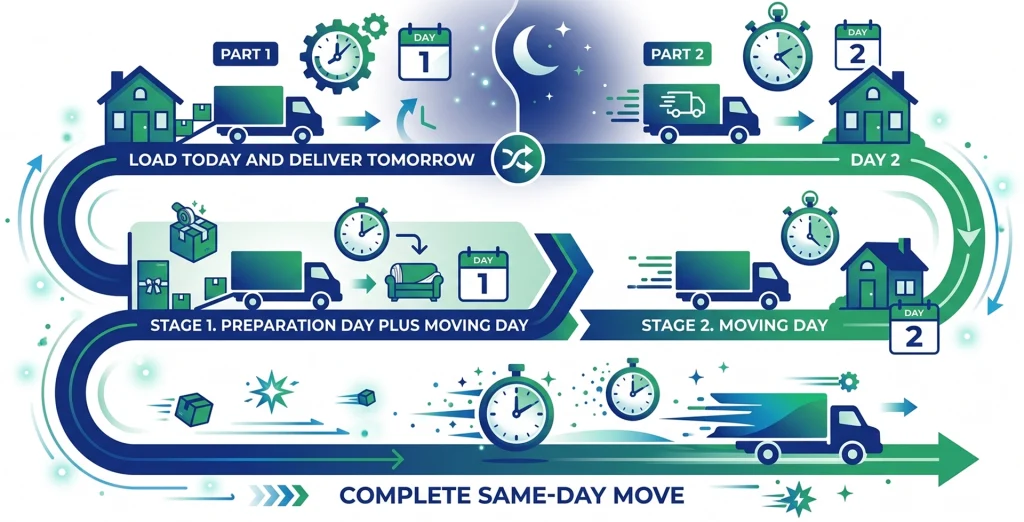
Complete Same-Day Move
The movers protect furniture, load the home, travel to the destination, unload, and complete essential reassembly on the same date. Beds, major seating, and necessary household items should be prioritized so the home is usable that evening.
Preparation Day and Moving Day
The first date covers packing, labelling, dismantling, and staging. The second date is reserved for loading, transportation, placement, and reassembly. This model keeps packing decisions from interrupting truck work.
Load Today and Deliver Tomorrow
The property is cleared on the first date, and the shipment is delivered after the destination becomes available. The agreement should explain truck sealing, overnight custody, delivery order, and which personal essentials stay with the family.
When the delivery gap may last longer than one night, compare planned storage solutions in Ottawa instead of assuming the shipment can remain on the moving truck.
How Each Scheduling Format Affects the Cost
A one-day move may require more movers, multiple trucks, extended labour, or waiting charges. A two-day arrangement may add another mobilization, extra travel, packing labour, or overnight holding.
Compare complete estimates rather than hourly rates. Each quote should show crew size, truck count, estimated hours, travel, packing, equipment, holding, and specialty-item charges. The lower-cost format depends on how the work is organized, not simply on the number of calendar days.
To compare the quotes properly, review how moving costs are calculated in Ontario and check that both options use the same inventory, access details, crew requirements and truck allocation.
See If Your Move Fits One Day
Call us today to compare labour, vehicles, access, and delivery timing.
What You Receive Before Booking
Before booking, you receive the recommended schedule, expected working hours, crew and truck allocation, services assigned to each date, and the assumptions used in the estimate.
When both formats are workable, the written comparison explains how the timing, services, and total cost would change. It also identifies any details that must be confirmed before the schedule becomes final.
Questions About Scheduling a Large Home Move
Can the family stay in the home between moving days?
Yes, provided essential furniture, medication, clothing, toiletries, chargers, and important documents remain available. Keep these items separate from the main shipment.
What should not go into overnight holding?
Keep passports, jewellery, medication, keys, laptops, legal documents, temperature-sensitive items, and anything needed the next morning with you.
Can cleaners enter between the two stages?
Yes. A gap between loading and delivery can create a useful cleaning window. Coordinate access so cleaners do not interfere with the movers or block remaining exits.
When selling a house, how long do you have to move out?
Your purchase agreement and lawyer determine when the property must be empty and the keys released. Confirm the exact handover deadline before scheduling the final loading period. Confirm the exact deadline with your lawyer.
Final Check Before Choosing the Schedule
Choose a same-day schedule only when packing is complete, property access is confirmed, and the full estimate fits inside the usable working hours with a realistic buffer. Use a staged schedule when the workload exceeds that window or when possession, packing, or delivery timing remains uncertain.
Get the Right Moving Schedule for Your Home
Share your property type, moving addresses, full room and storage inventory, required dates and unusual items with our residential movers in Ottawa. We will compare the workable scheduling formats and provide a written recommendation showing the expected labour, vehicles, services and cost.

Testimonials

Hardworking, focussed and polite. What surprised me was their care and attention detail, almost as if they were moving their own possessions. Thank you for your incredible service.
Contact Us

How It Works
Quality Services and
the Highest Level of Professionalism

Contact our team
Reach out to Professional Movers Ottawa via phone or e-mail


Get a free estimate
Consult with our agents on additional services you may need


Organize your move with ease
Let us guide you through a smooth moving process
