

Get Your Free Estimate Now
"*" indicates required fields


Moving between cities in Ontario is common, but a Toronto-to-Ottawa move requires a specialized Moving Checklist Ontario Long Distance strategy. This 450 km trip typically takes 5–6 hours and involves logistics that don’t exist in short moves. Unlike local relocations, delivery often falls into next-day windows due to:
-
GTA traffic and highway timing
-
Condo elevator bookings
-
Load size and building access
-
Long-haul packing requirements
These factors significantly influence your timeline and costs. That is why using a Moving from Toronto to Ottawa checklist is essential. This guide provides a practical 4-week timeline to help you stay organized and avoid last-minute surprises.
Planning a Move from Toronto to Ottawa: Your 4-Week Checklist
The biggest opportunity to save money on this 450 km relocation happens before you pack a single box, by planning the move properly over a clear four-week timeline.
Toronto condos often force people to live efficiently, while Ottawa homes usually offer more space and storage. However, more room doesn’t mean everything is worth transporting 450 km, so decluttering should be your first priority.
Declutter with Distance in Mind (450 km Rule)
- Declutter room by room, asking one key question: Is this item worth transporting 450 km?
- Reconsider moving flat-pack furniture, aging electronics, duplicate kitchenware, and rarely used décor—these often cost more to move than replace.
- Sell or donate items in Toronto to reduce truck weight, packing time, and overall moving costs.
- Decluttering early simplifies packing and helps you stay within tight, strictly enforced condo move-out windows in Toronto buildings.
Key takeaway: Less weight means fewer last-minute packing and condo access issues, faster loading, smoother highways, and lower costs over 450 km.
Here’s a quick visual guide to our 4-week Toronto-to-Ottawa moving plan.
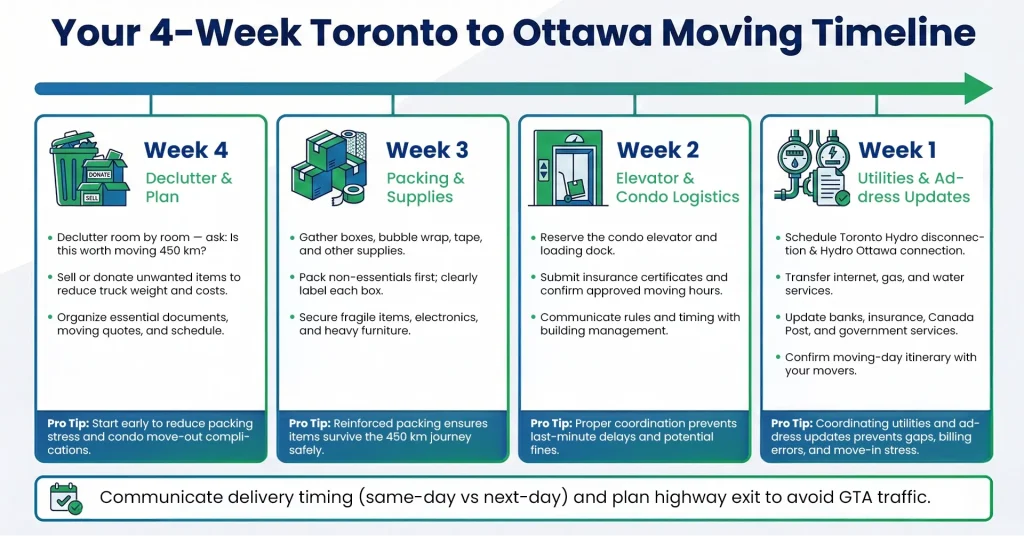
Toronto to Ottawa Moving Timeline — 2 Weeks Before Your Move
Elevator Booking & Condo Logistics
Generic relocating from Toronto to Ottawa guides often overlook this step, yet missing it can delay your move or trigger condo fines.
Proper elevator coordination keeps Toronto condo moves on schedule rather than turning into last-minute disruptions.
Most Toronto condo buildings require elevator bookings, certificates of insurance, and approved moving time slots. Missing this step can delay your move or result in fines.
Confirm the following with your building management:
- Elevator reservation time
- Loading dock access rules
- Building-approved moving hours
- Required documentation for movers
Long-distance moves need extra buffer time, and condo delays can push your departure into peak traffic hours, complicating a highway move.
Hiring a professional Toronto moving company adds real value by coordinating with building management, setting realistic loading timelines, and ensuring full condo compliance.
1 Week Before Your Toronto-to-Ottawa Move: Utilities & Address Updates
One week before your move, focus on services, utilities, and address updates, especially important when moving between cities in Ontario.
Schedule the following in advance:
- Disconnection from Toronto Hydro
- Connection setup with Hydro Ottawa
- Internet and cable transfers
- Gas and water services (if applicable)
Important planning note: Utility transfers in Ontario aren’t automatic. Managing Toronto Hydro vs Hydro Ottawa requires separate scheduling, and delays can leave you without power on move-in day. To avoid this, schedule disconnections at least 24 hours after your move date.
Complete your Ontario address updates:
- Banks and credit card providers
- Insurance companies
- Healthcare offices and pharmacies
- Government services (as part of your Change of address checklist, Ontario)
- Canada Post mail forwarding (activate early to avoid missed documents)
Why this matters: Coordinating utilities and address updates a week early prevents service gaps, billing errors, and move-in day stress during a Toronto-to-Ottawa relocation.
This is a great time to review long-distance moving costs, explore Ottawa neighbourhoods, and plan your relocation in detail with our Complete Ottawa 2026 Relocation Guide.
Toronto to Ottawa Route for Moving Trucks: Highway 401 vs Highway 7
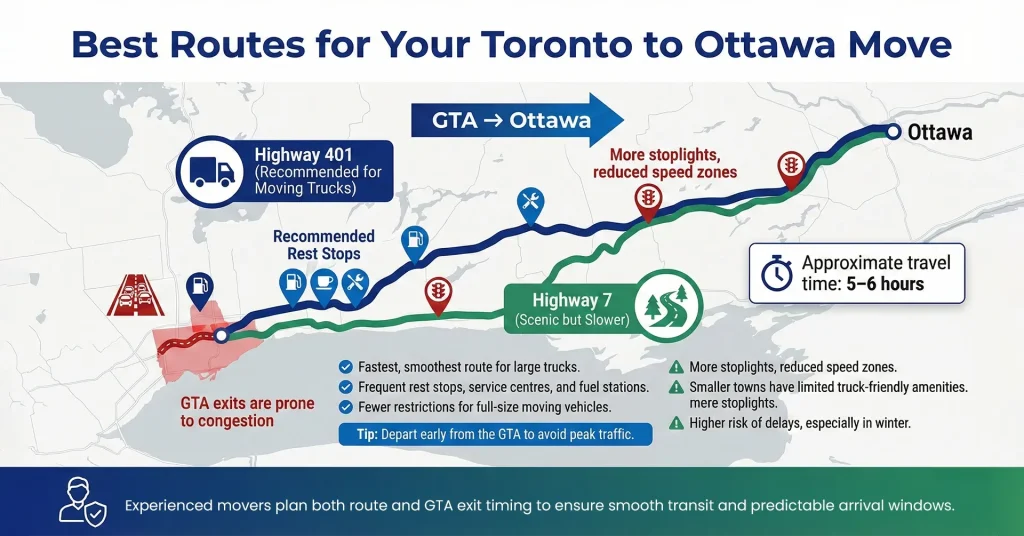
Choosing the right route for a Toronto-to-Ottawa move is about more than distance alone; it directly affects timing, fuel efficiency, and delivery predictability.
Highway 401 is the fastest and most commonly used route for large moving trucks. It offers:
- Better road conditions for heavy vehicles.
- More rest stops, service centres, and fuel access.
- Fewer restrictions for full-size moving trucks.
The main challenge with the 401 is getting out of the GTA.
Peak-hour traffic can create significant delays, which is why departure timing matters as much as route choice.
Highway 7, while scenic, is less suitable for long-haul moves. It includes:
- Frequent stoplights and reduced speed zones.
- Smaller towns and limited truck-friendly amenities.
- Increased risk of delays, especially during winter conditions.
For most relocations, the best route for moving trucks from Toronto to Ottawa (Hwy 401 vs Hwy 7) is Highway 401, paired with an early-morning departure to avoid congestion.
Key insight: Professional movers don’t just choose Highway 401—they time the GTA exit precisely to avoid congestion, protect transit schedules, and maintain reliable delivery windows from Toronto to Ottawa.
Toronto to Ottawa: Why Secure Packing Matters for a 450km Move
Local moves allow some flexibility, but long-distance moves do not. For a Moving checklist Ontario long distance, secure packing is essential to protect your belongings during the 450 km journey.
Items travelling this distance face:
- Hours at highway speeds
- Vibration, shifting, and possible overnight storage
- Potential delays or stops that can impact fragile items
Critical items that need extra care:
- Electronics and appliances
- Fragile décor, artwork, and mirrors
- Furniture and large, heavy items
Professional movers provide:
- Reinforced boxes and packing materials
- Protective wraps, padding, and bubble layers
- Load-securing techniques designed for long hauls
- Special handling for overnight delivery vs same-day delivery scenarios
Why it matters: Loose packing that might survive a 10 km move often fails during a 450 km Toronto-to-Ottawa move. Secure packing isn’t an upsell; it’s insurance for your move, ensuring your items arrive safely.

Insight for readers: Proper long-distance packing protects your valuables, minimizes stress, and ensures your 450 km Toronto-to-Ottawa move stays on schedule, so you spend less time fixing issues and more time settling into your new home.
What Moving Day Actually Looks Like (Toronto → Ottawa)
Understanding the moving-day flow removes uncertainty and anxiety, especially for a 450 km relocation.
A typical Toronto-to-Ottawa move itinerary might look like this:
- 8:00 AM — Moving crew arrives in Toronto
- 8:00–12:00 PM — Loading, elevator use, and documentation
- 12:00 PM — Truck departs Toronto
- 6:00 PM — Arrival in Ottawa (same-day delivery)
For larger moves, tight condo schedules, or late departures, next-day delivery may be more practical. In these cases, items are secured overnight and delivered the following morning.
Pro tip for your Toronto-to-Ottawa move: Clear communication with your movers about same-day vs. next-day delivery lets you plan essentials, arrange childcare or pet care, and avoid last-minute surprises. Coordinating your arrival window, elevator access, and unloading plan helps ensure the day runs smoothly, saving time, reducing stress, and avoiding potential fees.
Wrap-Up: Successfully Planning Your Toronto to Ottawa Move
Moving from Toronto to Ottawa brings condo, utility, traffic, and long-haul packing challenges, but careful planning makes them manageable. A clear 4-week moving timeline makes these logistics manageable and predictable.
Key steps to make your move smoother:
- Plan a route-specific itinerary: Optimize Highway 401 exit times and rest stops to avoid congestion in the GTA.
- Secure your items for the long haul: Use reinforced boxes, bubble wrap, and professional packing techniques to prevent damage.
- Coordinate condo and building logistics: Reserve elevators, submit insurance certificates, and confirm approved moving hours.
- Schedule utilities and address updates: Disconnect Toronto Hydro, connect Hydro Ottawa, and update banks, insurers, and postal services.
- Decide on same-day vs. next-day delivery: Communicate clearly with your movers to align arrival expectations and essentials planning.
- Enlist professional movers when possible: Let experts handle timing, loading, and logistics so you can focus on settling into your new home.
Final Thought: By following these steps, your Toronto-to-Ottawa move becomes smoother, safer, and far more predictable, reducing stress and unexpected delays. Plan your move with our Professional Movers’ team to save time, minimize stress, and ensure your belongings arrive safely.
Toronto to Ottawa Moving FAQs: Key Questions Answered
1. How far in advance should I book movers from Toronto to Ottawa?
Ideally, book 4–6 weeks in advance, especially during summer or month-end periods. Long-distance moves fill up quickly, and early scheduling gives you better flexibility for condo elevator reservations, preferred delivery windows, and route planning for your 450 km relocation.
2. How do I handle disconnecting utilities, Toronto Hydro vs Hydro Ottawa?
Utility transfers in Ontario aren’t automatic. Schedule Toronto Hydro disconnection and Hydro Ottawa connection at least 24 hours after your move to avoid service gaps. Also, update internet, cable, gas, and water services, and notify banks, insurers, and government offices as part of your change of address checklist in Ontario.
3. Which route is best for moving trucks from Toronto to Ottawa — Hwy 401 vs Hwy 7?
For long-distance Toronto-to-Ottawa moves, Highway 401 is generally faster, offers smoother roads, has frequent rest stops, and imposes fewer restrictions on large trucks. Highway 7 is more scenic but has smaller roads, more stoplights, and fewer amenities, making it less ideal for full-size moving trucks, especially in winter. Professionals often plan GTA exit timing carefully to avoid congestion.
4. What should I plan for when moving with pets from Toronto to Ottawa?
Pets should travel separately from the moving truck. Prepare a pet essential kit, schedule breaks, and keep them in a quiet, familiar space during the move. Planning this in advance reduces stress and ensures your Toronto-to-Ottawa relocation goes smoothly for everyone in your family.
Testimonials

Hardworking, focussed and polite. What surprised me was their care and attention detail, almost as if they were moving their own possessions. Thank you for your incredible service.
Contact Us

How It Works
Quality services and
the highest level of professionalism

Contact our team
Reach out to Professional Movers Ottawa via phone or e-mail


Get a free estimate
Consult with our agents on additional services you may need


Organize your move with ease
Let us guide you through a smooth moving process
