

Get Your Free Estimate Now
"*" indicates required fields









Moving later in life is rarely just about changing addresses. For many families, senior relocation in Ottawa means more than booking a truck. It can include downsizing a longtime home, moving into a retirement residence, helping an elderly parent relocate, arranging packing support, and deciding what to store, donate, sell, or take to the new space.
In Ottawa, some seniors move from larger homes in Kanata, Nepean, Barrhaven, Orleans, Alta Vista, Westboro, The Glebe, or Gloucester into condos, bungalows, retirement residences, assisted living suites, or smaller homes closer to family. Others move after retirement to be closer to adult children, reduce home maintenance, or begin a quieter next chapter outside the city.
Senior moves should not be treated like standard household moves. They often need more patience, earlier planning, clearer family communication, and a better system for sorting, packing, storage, donation, and room setup.
This guide explains what families should plan before moving day, how downsizing usually works, what can affect senior moving costs, and what to ask before hiring senior movers in Ottawa.
Quick Answer
A senior move in Ottawa usually involves more than packing boxes and loading a truck. The smoother moves are planned early, with the senior, adult children, retirement residence staff, and movers all clear on what will be moved, stored, donated, removed, and set up first in the new home.
What Senior Moving Services in Ottawa Can Include
Senior moving support can vary depending on the home, the new residence, and the amount of help the family needs. In many Ottawa senior moves, support may include:
- downsizing planning before moving day
- packing and labelling support
- furniture protection and careful loading
- retirement residence move-in coordination
- elevator, parking, and loading-area planning
- storage, donation, and disposal coordination
- unpacking and priority room setup
- clear communication with one family contact
- keeping medications, documents, mobility aids, and daily-use items separate from the main move
How This Guide Was Prepared
This guide was prepared to help seniors and families understand the practical planning involved in a senior move in Ottawa. It reflects common needs such as downsizing, packing support, storage coordination, furniture protection, elevator planning, retirement residence move-in rules, family communication, and new-home setup.
Reviewed by: Ontario Move Coordination Team, Professional Movers Ottawa
Last updated: 2026
Reviewed for: senior moving planning, downsizing, retirement residence access, packing support, storage coordination, elevator planning, and move-day setup.
After helping plan and handle moves across homes, condos, apartments, townhouses, and commercial spaces, one pattern is clear: the hardest part of a senior move is often not the truck. It is the preparation before the truck arrives.
This guide is meant to help families prepare the details that usually create confusion before moving day.
Why Relocating After Retirement in Ottawa Needs More Planning Than a Standard Move
A standard move often focuses on boxes, furniture, loading, transportation, and unloading. Senior moves include those steps, but often involve more personal decisions, family involvement, and timing details.
A senior may be moving out of a home they have lived in for 20, 30, or 40 years. There may be basement storage, garage tools, old paperwork, family furniture, seasonal items, sentimental belongings, and items that no longer fit in the next home.
The move may also involve adult children, a retirement residence coordinator, a building manager, healthcare appointments, or a real estate timeline.
A senior move may require:

For seniors, the emotional side of moving can matter as much as the physical work. Leaving a long-time family home in Nepean, Kanata, Orleans, Barrhaven, or Alta Vista can feel very different from a routine apartment move. A good plan leaves room for decisions, conversations, and a steady pace.
How Senior Moves Can Differ Across Ottawa
Not every senior move looks the same. The right plan depends on the home being left, the new space, the level of family support, and the amount of sorting required before moving day. The examples below show how local property types can change the planning, even when the move is still within the Ottawa area.
| Example Senior Move | What Usually Needs Planning |
|---|---|
| Kanata bungalow to Barrhaven retirement residence | Downsizing larger furniture, measuring the new suite, elevator booking, family coordination, and setting up essentials first. |
| Orleans townhouse to Central Ottawa condo | Stairs, packing support, truck access, condo elevator rules, parking, and storage decisions for items that may not fit. |
| Nepean family home to an assisted living suite | Room setup, medication and document access, donation planning, disposal decisions, and furniture selection. |
| Westboro condo to out-of-province family | Elevator access, limited parking, smaller inventory planning, long-distance timing, and clear family communication. |
| Alta Vista estate to retirement living | Basement and garage sorting, older furniture, sentimental items, donation planning, and possible short-term storage. |
Downsizing from a Long-Time Family Home
This is one of the most common situations for seniors moving in Ottawa. A senior may be moving from a detached home in Kanata, Nepean, Barrhaven, Orleans, Alta Vista, or Gloucester into a smaller condo, bungalow, apartment, or retirement residence.
These moves often involve more belongings than expected. Basements, garages, spare rooms, sheds, filing cabinets, and storage closets may all need attention before packing starts. The biggest challenge is deciding what truly fits the next home.
Moving Into a Retirement Residence
A move into a retirement residence usually needs careful timing. The family may need to confirm suite access, elevator booking, move-in hours, parking, furniture size, and residence-specific instructions.
The goal is not only to move items safely, but to make the new suite usable and comfortable as quickly as possible. Bed placement, clothing, toiletries, medications, favourite chairs, framed photos, lamps, and daily-use items should be prioritized.
Pro-tip for families: When researching local senior living options, families can consult the official Retirement Homes Regulatory Authority (RHRA) public register. The register can help families review licensed retirement homes in Ontario before choosing a residence.
Moving to Assisted Living or Memory Care
Moves into assisted living or memory care need extra care because routine, comfort, and familiarity can be important. Families may want to recreate parts of the previous room layout, bring familiar furniture, and keep essential belongings visible and easy to find.
In these moves, small details matter. Photos, bedding, a favourite chair, labelled clothing, mobility aids, and personal items should not be buried in random boxes.
This is where experience with assisted living moves in Ottawa makes a difference. It is not only about transportation; it is also about timing, patience, and helping the new space feel set up from the start.
Moving Closer to Adult Children
Many senior moves are coordinated by adult children rather than by the senior moving themselves. Some family members are local and able to help in person. Others may be organizing the move remotely from Toronto, Kingston, Montreal, Calgary, Vancouver, or another city while coordinating details by phone, email, and video calls.
This creates a different planning challenge. The moving company, family, senior, and new residence may all need clear communication before moving day. Inventory photos, labelled boxes, floor plans, and a written move-day contact list can reduce confusion.
Moving From Ottawa After Retirement
Some retirees choose to leave Ottawa completely after retirement. They may move to a smaller Ontario community, a quieter suburb, a waterfront area, another province, or closer to family.
When moving from Ottawa after retirement, the planning should start with lifestyle and support needs. Healthcare access, family proximity, housing costs, weather, transportation, and home maintenance all matter. The moving plan should also account for long-distance travel, storage, packing, and what can realistically fit in the new home.
How Seniors Can Downsize Before Moving in Ottawa
Senior downsizing in Ottawa is rarely a one-day task. The process usually feels more manageable when it begins early and is approached room by room. For many seniors, downsizing is not only about removing items. It is about making careful decisions around a lifetime of belongings.
A practical downsizing plan usually separates belongings into five groups:
- Keep: items that fit the new home and will be used regularly.
- Give: family belongings with personal, sentimental, or family value.
- Donate: usable household items, clothing, books, and furniture.
- Store temporarily: items the family is not ready to decide on yet.
- Dispose of or recycle: damaged, unsafe, or unwanted items before moving day.
The most difficult areas are often basements, garages, storage rooms, bookshelves, filing cabinets, china cabinets, and older furniture sets. These spaces can hold years of items that were kept because there was enough room, not because they are still needed.
Before packing begins, families should measure the new space. A sofa that fits a detached home in Kanata may not fit an elevator in a retirement suite or a smaller condo living room. A large dining set from a Barrhaven home may not work in a one-bedroom apartment. Measuring furniture early prevents stressful decisions on moving day.
For some families, professional downsizing support becomes useful when there are too many belongings to sort before moving day. Seniors and families often need help deciding what to take, not only help moving what is already packed.
How Much Do Senior Moving Services Cost in Ottawa?
The cost of senior moving services in Ottawa depends on the level of support needed before, during, and after moving day. A small retirement residence move may only need a simple crew setup. A full downsizing move from a long-time family home may require packing, furniture protection, storage planning, donation coordination, and extra sorting time.
Because senior moves vary widely, the most useful estimate usually starts with the support level, not distance alone.
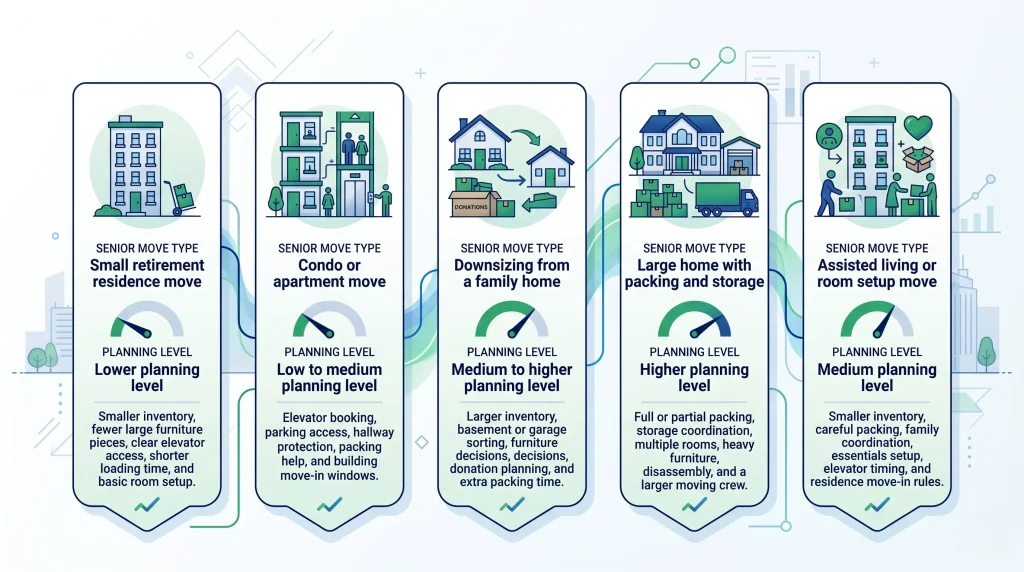
These are planning categories, not fixed prices. A move can also take longer when basement items, garage shelves, unpacked kitchens, or unlabelled boxes are not sorted before the crew arrives.
For a more realistic estimate, families should share the current home size, new residence type, furniture list, packing needs, storage plans, elevator rules, and the main contact for moving day.
Senior Moving Cost Details Ottawa Families Often Miss
Some senior moving costs change because small details are not discussed early enough. These details are easy to miss during the first quote conversation, especially when the family is focused on the move date, the new residence, or the downsizing process.
Basement storage, garage shelves, unpacked kitchens, heavy furniture, short elevator windows, long carries, donation stops, and temporary storage can all affect the time needed on moving day.
For example, a small retirement residence move may still take longer if the elevator window is short or the truck cannot park close to the entrance. A family home downsizing move may also need more time if garage items, filing cabinets, tools, books, or older furniture are not sorted before the crew arrives.
Sharing these details early helps the moving team plan the right crew size, truck space, packing support, and timing.
Common Items Families Forget Before a Senior Move
In many Ottawa senior moving requests, especially from larger family homes in Kanata, Nepean, Barrhaven, Orléans, and Alta Vista, families prepare the main furniture list first but often miss basement shelves, garage tools, filing cabinets, donation boxes, and storage items. Before asking for a quote, walk through these areas and decide what the movers should take, what the family wants to donate, what needs storage, and what should be removed before moving day. These overlooked areas can increase moving time and affect the final cost, even when the new residence is close by.
Moving to a Retirement Residence, Condo, or Assisted Living Community in Ottawa
A move to a retirement residence or condo comes with its own logistics. It is very different from moving into a detached home with direct driveway access.
Before moving day, families should confirm the move-in date, allowed hours, elevator reservation, loading area, suite number, access route, and main contact at the residence or building.
It is also worth asking whether floor protection, wall protection, proof of insurance, truck parking instructions, or special move-in rules are required.
For Ottawa condos and retirement buildings, elevator timing can shape the whole move. A missed or delayed elevator window can disrupt the day. If the building does not have a private loading area, the moving crew may need extra time for longer carries through lobbies, parking areas, corridors, or service entrances.
If street parking near the pickup or delivery address is limited, families can review the City of Ottawa’s temporary consideration parking permit information before moving day.
What Should Be Set Up First After a Senior Move?
The first few hours after a senior move can feel overwhelming, especially in a new and unfamiliar space. Setting up the most important daily-use items first can help make the first evening more comfortable and reduce unnecessary stress.
Priority items to set up first often include:

Focusing on these essentials first helps a senior settle in faster, feel more at ease in the new home, and makes the first night easier.
Moving Elderly Parents in Ottawa With Care and Clear Planning
Adult children often become the main organizers of a senior move. The process can feel overwhelming when a parent is attached to a long-time family home or unsure about the change.
Clear roles are helpful before moving day so everyone knows what to focus on. In family-led moves, one person may coordinate with the movers, another can keep important documents and medications close by, while someone else handles donation or storage decisions.
It can also make a big difference to have one family member focused entirely on the senior’s comfort, routine, and support throughout the move. Clear communication helps avoid too many people giving instructions at once.
When siblings are involved, dividing tasks early can prevent confusion and last-minute disagreements. The moving crew can handle the heavy lifting, but family support helps the senior feel calm, heard, and comfortable during the transition.
How Senior Moving Support Usually Works
Senior moves often involve more planning than a standard household move. Families usually want to understand how the process works before choosing a mover or setting a move date. While every relocation is different, senior moving support in Ottawa usually follows a few common stages:
Planning Call
The planning call helps clarify the current home, the new address, inventory size, stairs, elevators, parking, packing needs, storage needs, and family involvement. At this stage, the senior or family can also explain mobility concerns, building rules, or timing restrictions.
Downsizing and Inventory Review
Before packing begins, the family should decide what will move, what may be donated, what may be stored, and what should be removed before moving day. Reviewing the inventory early helps avoid loading items that may not fit the new home.
Packing and Labelling
Packing is usually easiest when organized by room and priority. Essentials such as medications, important documents, chargers, glasses, toiletries, and other everyday-use items should be packed separately so they can be found quickly right after the move.
Move-Day Coordination
On moving day, coordination usually follows the elevator booking, residence move-in schedule, truck parking arrangements, and the family communication plan. It also helps to have one family contact available throughout the move to answer questions and confirm where important items should be placed.
Unpacking and Room Setup
For senior moves, the priority is to make the new space feel settled right away. The bed, comfortable seating, bathroom essentials, clothing, medications, phone, and everyday-use items are usually unpacked and set up first, while less urgent boxes can wait until later.
Storage, Donation, Disposal, and Junk Removal Planning
Many seniors move because the new home is smaller than the current one. Storage can help when the family needs more time to decide what to keep. Donation works well for usable furniture, clothing, books, kitchen items, and household goods. Junk removal may be needed for broken furniture, old mattresses, damaged items, or garage clutter. Planning storage, donation, and disposal early helps keep the moving truck focused on items that truly belong in the new home.
Ottawa Senior Moving Checklist
| Timeline | What to Confirm |
|---|---|
| 6-8 weeks before the move | Confirm the new address or retirement suite number; get the floor plan and room measurements; start downsizing from the basement and garage; measure key furniture; ask the new building or residence about move-in rules and elevator booking; book senior movers early. |
| 3-4 weeks before the move | Sort items into keep, family, donate, store, and dispose; confirm packing help; set aside medical, financial, and legal documents; share the move plan with family members; check truck parking or loading access; start packing non-essential items. |
| 1-2 weeks before the move | Reconfirm moving date, arrival window, and crew details; confirm elevator booking; finish labelling boxes; arrange donation drop-offs or storage; pack a day-one essentials box; decide family roles for moving day. |
| Moving day | Keep medications, ID, health cards, and important papers with the family; walk movers through the home; confirm what goes to the new home, storage, donation, or disposal; have the bed, chair, and daily-use items set up first; keep communication clear between the family lead, movers, and residence staff. |
Bottom line:
The more these details are organized in advance, the smoother and less stressful a senior move usually becomes.
What Can Go Wrong During a Senior Move
Many senior moves become harder when core decisions are left until the final week. These are the problems families should try to avoid:
- delaying the downsizing process until the final weeks before a real estate closing date
- moving heavy family furniture without measuring the destination suite
- failing to reserve service elevator slots or loading dock access with building management
- packing medications, health cards, or financial paperwork inside random moving boxes
- leaving garage, shed, or basement areas disorganized until move-day morning
- not choosing one family contact to direct the moving crew
- trying to fit too many large furniture pieces into a smaller retirement suite
- assuming a retirement residence allows move-ins at any time of day or weekend
- not using a clear room labelling system on boxes
- failing to plan where overflow items should go: storage, donation, disposal, or family pickup
A senior transition should feel organized and respectful. Handling these details early can make the move easier to manage.
Qualifying Questions to Ask Senior Moving Companies in Ottawa
Before choosing a local moving provider, families should ask questions that show whether the company has real experience with senior relocations:
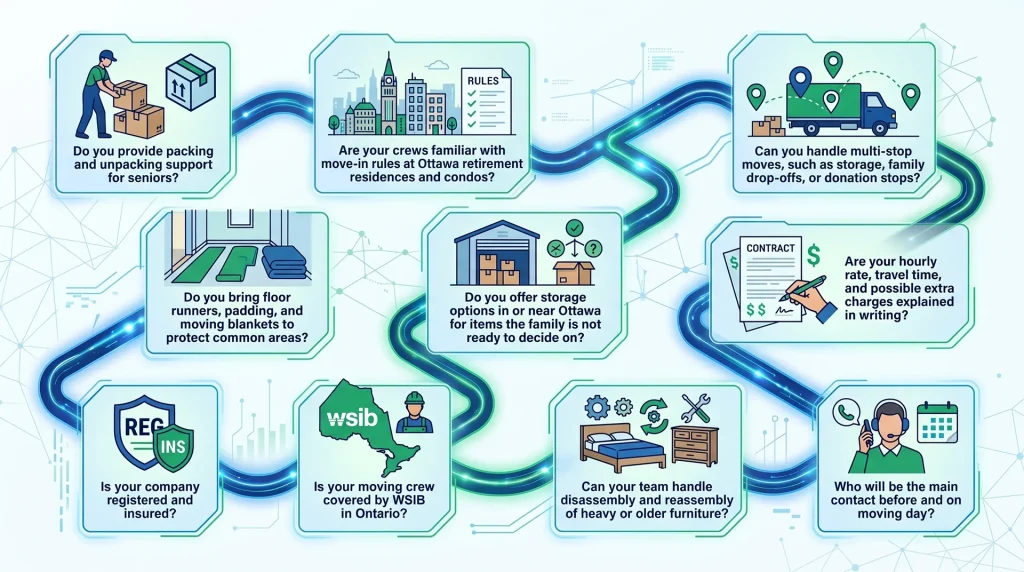
Provincial compliance note: In Ontario, families can ask whether the moving company carries WSIB coverage and proper insurance. A WSIB clearance can help show that a business is registered with WSIB and in good standing for its reporting and payment requirements.
Final Thoughts: Moving After Retirement in Ottawa Starts With the Right Plan
A senior relocation is about more than lifting furniture and moving boxes. It is a meaningful transition that often helps a loved one move into a safer, simpler, and more manageable living situation with less stress.
Your family may be planning a major downsizing project in Kanata, moving into a condo in Westboro, transitioning into a retirement community in Barrhaven, or relocating from Ottawa after retirement. Each situation has its own details, but the best moves usually start with a clear and practical plan.
Families should begin with the new living arrangement. Understand the size of the new space, measure important furniture, sort belongings early, confirm building or residence requirements, and keep medications, documents, mobility aids, and daily-use items separate from the main move.
Most importantly, choose support that understands the difference between a standard household move and a senior transition. The right planning can make moving day feel more organized, respectful, and easier for everyone involved.
Why Ottawa Families Choose Professional Movers Ottawa
Professional Movers Ottawa supports senior moves with packing help, furniture protection, loading, transportation, storage coordination, and move-day planning. Families can ask about insurance, WSIB coverage, packing materials, elevator coordination, and storage options before booking.
Get Help With Senior Moving in Ottawa
Planning a senior move for yourself, a parent, or a family member can feel easier with the right support in place. Professional Movers Ottawa helps with packing, furniture protection, loading, transportation, storage coordination, and move-day planning for senior moves across Ottawa and nearby communities.
If you are preparing for a retirement residence move, downsizing from a long-time home, or helping an elderly parent relocate, contact Professional Movers Ottawa or request a quote online +1 613-319-2488 to discuss the details of your move.
Questions Families Ask Before Booking Senior Moves in Ottawa
How much do senior moving services cost in Ottawa?
Senior moving costs depend on home size, furniture volume, packing needs, stairs, elevator access, storage, donation stops, and move-day support. A retirement residence move may take less time. A full downsizing move from a long-time home usually needs more planning.
What is included in senior moving services in Ottawa?
Senior moving services can include packing, furniture protection, loading, transportation, unloading, unpacking, room setup, storage coordination, and downsizing support. Families should confirm which services are included before booking.
Can movers help move a parent into a retirement residence in Ottawa?
Yes. Movers can move furniture, boxes, essentials, and personal items into a retirement residence. Families should confirm elevator booking, move-in hours, parking, suite access, and residence rules before moving day.
How far in advance should families book senior movers in Ottawa?
Families should book early, especially for downsizing, retirement residence moves, elevator booking, packing help, storage, or family coordination. Early planning gives everyone more time to sort belongings and confirm building rules.
Do senior movers help with packing and unpacking?
Yes. Senior moving support can include packing, labelling, furniture protection, loading, unloading, unpacking, and basic room setup. The exact support depends on the service level selected.
What should seniors pack separately during a move?
Keep medications, health cards, documents, mobility aids, phone chargers, toiletries, nightwear, glasses, and daily-use items separate from the main boxes. These items should stay easy to access.
Can movers coordinate with retirement residences in Ottawa?
Movers can work around elevator bookings, loading areas, move-in windows, parking instructions, and residence rules. Families should share these details before moving day so the crew can plan access properly.
How can adult children help with a senior move?
Adult children can choose one family contact, sort belongings early, prepare a floor plan, protect documents, and decide what the movers should take, store, donate, or leave behind.
What makes senior moving different from a standard move?
Senior moving often involves downsizing, family communication, sentimental belongings, retirement residence rules, packing help, donation decisions, storage planning, and priority room setup. It usually needs more planning than a standard household move.

Testimonials

Hardworking, focussed and polite. What surprised me was their care and attention detail, almost as if they were moving their own possessions. Thank you for your incredible service.
Contact Us

How It Works
Quality Services and
the Highest Level of Professionalism

Contact our team
Reach out to Professional Movers Ottawa via phone or e-mail


Get a free estimate
Consult with our agents on additional services you may need


Organize your move with ease
Let us guide you through a smooth moving process
