

Get Your Free Estimate Now
"*" indicates required fields









Relocating to a rental property in Ottawa can look simple at first. You sign the lease, get the keys, and choose a moving date. But as move-in day approaches, small details can quickly affect the schedule.
Apartments, condos, townhomes, and rental houses across Downtown Ottawa, Centretown, The Glebe, Sandy Hill, Kanata, Nepean, and Barrhaven do not all work the same way.
Some buildings require elevator bookings, loading dock approval, concierge instructions, or specific move-in hours. Others may have underground parking limits, narrow stairways, shared driveways, or larger household inventories to plan around.
For many renters, especially first-time tenants, delays often come from things that were not confirmed early enough.
The elevator may already be booked, the truck may not fit where expected, the loading area may need permission, or utilities may not be ready when they arrive.
A rental move usually goes more smoothly when access, timing, parking, utilities, and packing details are checked before the moving truck shows up.
That is why early planning matters before tenants lock in a moving date or wait until the final week.

Why Early Planning Matters for Ottawa Rental Moves
Ottawa rental moves tend to become busier during summer and month-end periods. Student transitions, lease turnovers, condo relocations, work-related moves, and family moves can all create tighter scheduling windows across the city.
The planning pressure also changes by area. In Downtown Ottawa and Centretown, tenants may need to work around elevator bookings, loading dock access, paid parking areas, limited curb space, and fixed building move-in hours.
Around Sandy Hill and the University of Ottawa area, student turnover and older rental buildings can complicate timing, stair access, and truck placement during busy lease-change periods.
In The Glebe and near Lansdowne, narrower streets, event traffic, and older residential layouts may limit where a moving truck can stop.
Areas such as Kanata, Barrhaven, and Nepean may involve larger inventories, garage items, basement storage, or townhome layouts that require more loading time.
Kanata North can also involve work-related rental moves because of the area’s office and tech presence.
For tenants, early planning is mainly about knowing the access, timing, and parking conditions before the moving date is finalized.
If elevator access, truck parking, or the move-in window is still unclear, those details should be confirmed first before locking in the final moving schedule.
What Ottawa Tenants Should Confirm Before Booking Movers
Before requesting moving services in Ottawa, tenants should confirm the practical details that affect building access, crew planning, and move timing.
A short conversation with the landlord, condo manager, concierge, or building management can often prevent scheduling problems later.
When possible, tenants should keep written confirmation of elevator bookings, parking instructions, or building move-in rules.

A move-in preparation checklist may include:

These details help movers understand the access conditions before the crew arrives.
For condo and apartment moves in Ottawa, the information tenants confirm before booking can affect the estimated labour time, crew size, truck placement, and overall move-day schedule.
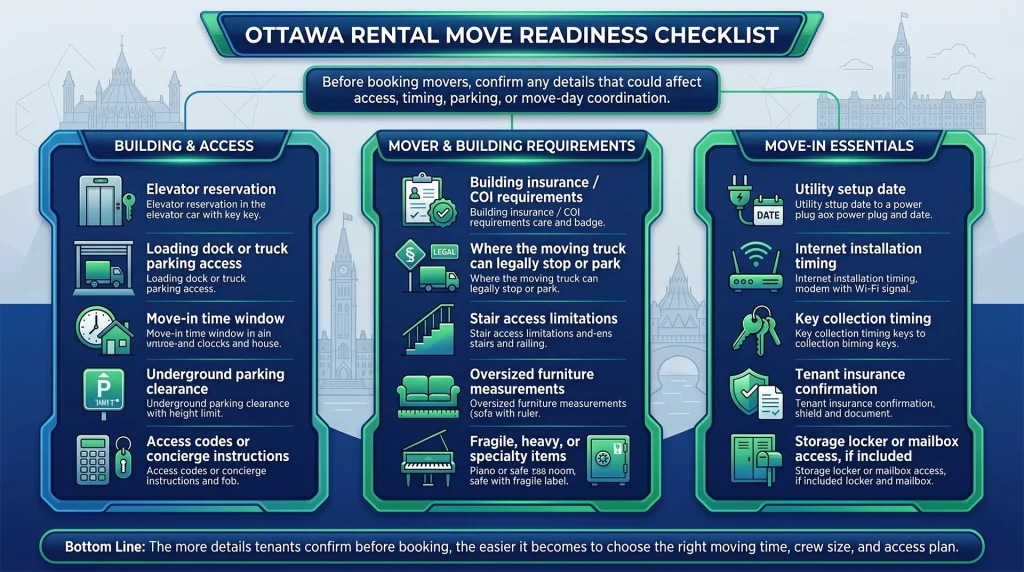
Why Elevator and Loading Access Matter in Ottawa Rental Moves
In Ottawa apartment and condo moves, the driving time is often not the biggest issue.
A short move across Centretown or into a high-rise in Westboro can still take longer than expected if elevator access, truck placement, or loading distance is not planned properly.
Building Access Can Take More Time Than the Drive
Many renters assume that a small apartment move will be quick. In reality, the building can create a delay.
Service elevator availability, loading dock access, underground parking clearance, concierge instructions, and walking distance from the truck to the unit can all affect how long the move takes.
Truck Placement Affects Labour Time
In high-density areas such as Centretown, Downtown Ottawa, Westboro, Rideau Street, and Laurier Avenue, tenants should confirm whether the building has a reserved service elevator, a dedicated loading area, and enough clearance for the moving truck.
If the truck cannot park close to the entrance, movers may need to carry items farther, which can increase labour time.
Building Rules Should Be Confirmed Before Move Day
Tenants should also ask building management about move-in windows, elevator keys, hallway protection rules, and any refundable move-in deposits before the scheduled date.
In areas such as The Glebe, Sandy Hill, and near the Parliament District, parking can be more difficult, so tenants may also need to check whether a temporary parking permit or approved loading arrangement is required.
Expert Verdict: A move in Ottawa is a logistical operation, not just a transport task. Success isn’t measured in kilometres, but rather in minutes per elevator trip. By managing your building access rules early, you transition your move from “unpredictable” to “scheduled.”
Setting Up Utilities Before Moving Into an Ottawa Rental
In Ottawa, the “Busy Summer Season” (May–September) means utility and internet providers have massive backlogs. If a technician is scheduled for the same 3-hour window as your movers, you could face a logistical gridlock.
Many renters focus on the physical move but treat utilities as an afterthought. In Ottawa’s rental market, not matching your service dates with your move-in date can create delays and make the first day harder than it needs to be.
1. Hydro Ottawa: The 10-Day Rule
Hydro Ottawa recommends submitting moving requests at least 10 business days before moving day.
The Mover’s Perspective: If hydro is not active, tenants may experience issues with lighting, appliance checks, device charging, and basic setup after move-in. In darker hallways or units, moving heavy furniture can also become less safe and more difficult.
Submit your request online early and keep the confirmation number with your move-in documents. You may need your move-in date and landlord contact details.
2. Internet Installation vs. Elevator Access
Scheduling your Bell, Rogers, or Videotron technician for the same afternoon as your movers can create problems.
The Conflict: In many Ottawa apartment and condo buildings, technicians and movers may need access to the same elevator, loading area, parking space, or concierge entry. If both arrive at the same time, one may have to wait.
The Fix: Schedule internet installation before the move, after the movers leave, or with a clear time gap between both appointments.
3. Tenant Insurance: Required Paperwork
Some Ottawa landlords, condo buildings, or property managers may ask for proof of tenant insurance before move-in, especially if it is required by the lease or building policies.
The Risk: If required documents are missing, key pickup, elevator access, or building approval may be delayed.
What to Arrange: Check your lease, confirm what proof is needed, and send the insurance document before moving day if required.
4. Key Collection & Proximity Fobs
Do not assume keys, fobs, mailbox access, parking remotes, or building codes will be ready exactly when the movers arrive.
The Reality: If your lease starts on the 1st, but the previous tenant is still moving out or the building office has not released access yet, your move can be delayed.
Confirm the exact key pickup time, who will hand over access, and whether you need to collect fobs, remotes, or codes before the moving truck arrives at the property.
Summary Checklist for Ottawa Renters
- Hydro Ottawa: 10 days’ notice (Electricity).
- Enbridge Gas: 1 week notice (if the unit has a gas range or heater).
- Tenant Insurance: Policy is active, and the certificate has been emailed to the landlord.
- Telecom: Tech appointment booked 24 hours after move-day.
Move-In Documentation for Ottawa Rental Properties
In Ottawa’s rental market, the transition between tenants happens fast. Before a single box is moved inside, documenting the property’s Day Zero condition is the only way to distinguish between pre-existing issues and move-day accidents.
In Ontario, since landlords cannot legally collect a security deposit for damages, they must file a claim through the Landlord and Tenant Board (LTB) to recover repair costs. Without a baseline record, it becomes your word against theirs.
1. The Empty Unit Walkthrough
Once you have the keys, do a 10-minute walkthrough before the moving truck arrives.
- The Goal: Capture the unit in its cleanest, emptiest state. This proves that any scuffs on the walls or dents in the floor were present before your movers started their work.
- Key Targets: Flooring Transit Paths: Check the hardwood or tile near the entrance and narrow hallways where heavy furniture will travel.
- Door Frames & Trim: These are the most common areas for minor dings during a move.
- Appliance Baselines: Open the oven and fridge. If they aren’t clean at move-in, you shouldn’t be held to a professional deep-clean standard at move-out.
2. High-Density Specifics: Balconies and Storage
In Ottawa condo towers (like those in Hintonburg or New Edinburgh), don’t forget the external areas:
- The Storage Locker: Document the walls and floor of your locker. If there is existing water damage or oil stains, you need a timestamped photo to avoid liability for “improper storage” later.
- The Parking Bay: If your spot has oil leaks from a previous tenant’s vehicle, photograph it immediately. Property managers often charge high remediation fees for cleaning underground concrete.
3. Strategic Record Keeping
Don’t just take photos; create a Digital Move Folder. This is an essential “Trust Signal” if you ever have to go before the LTB.
- Timestamp Everything: Use a camera app that embeds the date and time directly onto the image.
- The “Key Count”: Take a photo of all keys, fobs, and mail keys on the kitchen counter. This prevents disputes over “unreturned fobs” ($50–$100 each in most Ottawa condos) at the end of your lease.
Apartment, Condo, and Townhouse Moves: How Property Type Shapes the Move Plan in Ottawa
In Ottawa, local moving isn’t a one-size-fits-all service. The logistics of a high-rise in Centretown have almost nothing in common with a multi-floor townhouse in Kanata. To keep your move on schedule, your plan must account for the specific friction points of your property type.
High-Rise & Condo Moves (The Vertical Challenge)
Relocating in Downtown Ottawa, Westboro, or the ByWard Market is governed by building management protocols.
- The Constraint: You are often limited to a strict 3-hour service elevator window.
- The Reality: If your movers are inexperienced with downtown loading docks or shared hallway protection rules, a 15-minute delay can result in a “hard stop” from the concierge, leaving half your furniture on the truck.
- Key Detail: Always verify underground parking clearance. Many newer towers have limits as low as 8’2″, while a professional 5-ton truck requires 12’6″.
Townhomes & Semi-Detached (The “Space” Challenge)
Rental moves in suburban hubs like Barrhaven, Nepean, and Orléans present a different set of obstacles.
- The Constraint: Narrow staircases and shared driveways.
- The Reality: Moving a king-sized mattress or a sectional sofa through a standard Nepean townhouse often requires “maneuver time.” Tight entrances and multi-floor loading mean the crew spends more time navigating corners than they do actually lifting.
- Key Detail: If you share a driveway, notify your neighbours 48 hours in advance. A blocked driveway in a high-density townhouse complex is the #1 cause of move-day stress.
Detached Rental Homes (The “Volume” Challenge)
While detached homes in Kanata or Stittsville offer easier truck parking, they often hide the largest inventories.
- The Constraint: Basements, garages, and outdoor spaces.
- The Reality: People tend to accumulate 25% more “hidden” inventory in detached homes. Patio furniture, heavy basement storage bins, and garage tools add significant weight and volume that can exceed the capacity of a smaller truck if not reported early.
How Access and Local Geography Shape Ottawa Rental Moves
A successful Ottawa move happens when inventory, property layout, and local geography are synchronized.
- Centretown/Sandy Hill: Plan for one-way streets and limited street parking permits.
- Kanata/Orléans: Plan for multi-floor transit and garage-to-truck loading flow.
Key Movers Insight: Your property type is the single biggest variable in your moving quote. A 2-bedroom move in a Westboro high-rise will take longer than a 2-bedroom bungalow move in Nepean because of the vertical transit time. Always provide your movers with the floor count and elevator status to ensure your estimate remains accurate.
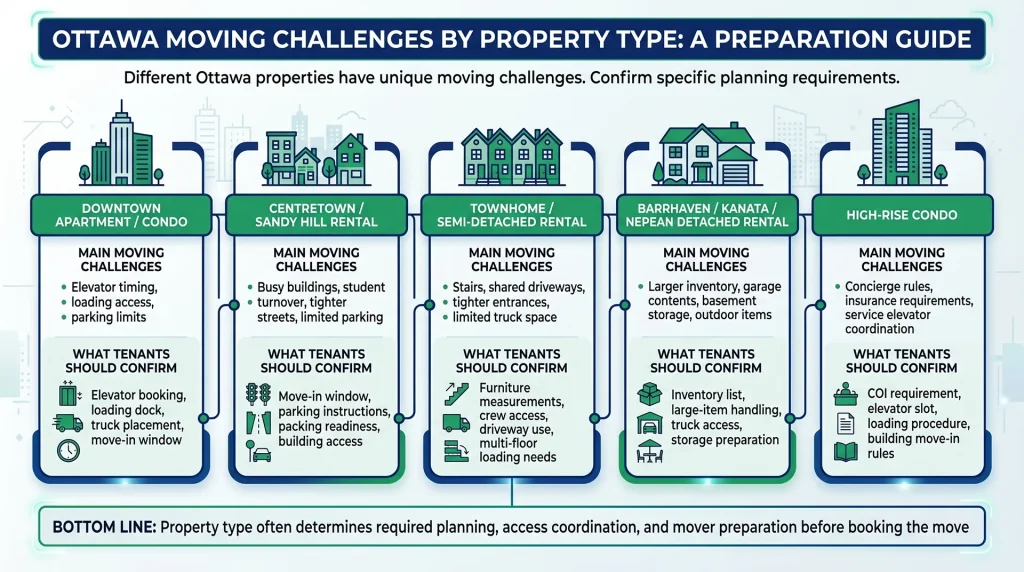
How Inventory Organization Helps Ottawa Rental Moves Stay on Schedule
One part of rental move preparation that tenants often underestimate is organizing their inventory.
Before movers arrive, it helps to know which items need careful handling, which boxes should be loaded first, and which belongings may need to go into storage.
Tenants can prepare by:
- separating fragile belongings
- labelling priority boxes
- identifying items for storage
- measuring larger furniture pieces
- clearing appliance access paths
- organizing valuables separately
This helps improve loading efficiency and reduces confusion once the move begins.
For Ottawa condo and apartment moves, organized packing can also help reduce elevator wait times, hallway congestion, and unnecessary back-and-forth in shared residential buildings.
When the inventory is prepared before moving day, the move usually becomes easier to coordinate for both the tenant and the moving crew.
Ottawa Rental Move Timing: Student Turnover, Month-End Demand, and Weather
Ottawa rental moves are often shaped by the calendar, especially during late spring, summer, month-end periods, and student turnover windows.
During these times, tenants may have less flexibility with elevator bookings, loading access, mover availability, and preferred move-in times.
Student Turnover Can Create Extra Pressure Near Campus Areas
Carleton University, the University of Ottawa, and Algonquin College all contribute to seasonal rental activity across the city.
Around Sandy Hill, The Glebe, Little Italy, and areas near campus, April to May and August to September can be busier because many leases, student moves, and shared rental transitions happen close together.
In older rental buildings, tenants may also need to plan for tighter staircases, limited parking, and no service elevator.
Month-End Moves Can Be Harder to Schedule
Many rental moves occur near the beginning or end of the month, which can create more competition for elevator slots, loading areas, and moving crews.
In larger apartment or condo buildings in Centretown, Westboro, and Downtown Ottawa, tenants may need to reserve building access early and confirm whether the loading area is actually booked for their move, not just generally available.
Summer Events and Roadwork Can Affect Downtown Moves
During the summer, traffic around the Downtown Core, ByWard Market, LeBreton Flats, and event areas can change due to festivals, roadwork, or special-event closures.
Before moving day, tenants should check the City of Ottawa traffic updates and confirm whether the moving truck route or loading area could be affected.
Winter Moves Need Extra Access Preparation
In January and February, snowbanks, icy walkways, and uncleared driveways can slow down loading.
Tenants moving into townhomes, detached rentals, or low-rise buildings should ensure that walkways, stairs, driveways, and entrances are clear before the movers arrive.
If the truck cannot park close to the entrance, the move may take longer because of the extra carrying distance.
What Ottawa Tenants Should Look for in a Moving Company
Rental moves in Ottawa often involve more than the tenant and the moving crew.
Depending on the property, the move may also require coordination with a landlord, building manager, concierge desk, condo office, or parking authority.
That is why renters should look beyond the hourly rate. A prepared mover should ask about the property type, building access, truck placement, elevator timing, and any move-in restrictions before confirming the plan.
For apartment and condo moves in Centretown, Westboro, Downtown Ottawa, or the ByWard Market, this may involve questions about service elevators, loading areas, and reserved move-in windows.
For rentals in The Glebe, Sandy Hill, or near the Parliament District, it may involve curb space, street access, or longer carrying distances.
A reliable mover should ask the right access questions before moving day, not after arriving at the property.
A Smoother Ottawa Move Starts Before Moving Day
Moving into a rental property in Ottawa often involves more coordination than many tenants initially expect.
The lease is important, but the building rules, access conditions, and move-in timing can also shape how smoothly the day goes.
The smoothest rental moves are usually planned before moving day, not figured out on the day itself.
Whether the move involves a downtown apartment, a condo in Centretown, or a townhome in Barrhaven or Kanata, practical preparation can reduce delays and make the move easier to coordinate.
For tenants, the best approach is to confirm the key details early, choose a moving date that matches the property conditions, and work with movers who understand Ottawa rental moves.
Ottawa Rental Moves: Planned Around Access, Timing, and Building Rules
Moving into a rental in Ottawa is not just about transporting boxes from one address to another. Elevator bookings, parking access, move-in windows, building rules, and property type can all affect how smoothly the move goes.
You do not need a mover who only gives an hourly rate. You need a team that understands how Ottawa apartment, condo, townhome, and rental house moves actually work.
If you are preparing for a rental move in Ottawa, Professional Movers Ottawa can help you plan around building access, truck placement, inventory size, and move-in timing.
Get Your Free Moving Quote: Call +1 647-495-6910 for a detailed estimate based on your rental type, access conditions, inventory size, and moving date.
While you’re looking for a decent apartment, set aside some time to find capable movers as well. Your fresh start begins with the right moving company! Therefore, don’t forget the importance of a joyful moving experience. That’s why true moving professionals are your best choice. Not only do they value your time, but they also value your best interest. In addition, they take good care of customers’ belongings. The market is filled with various moving companies that fit within anyone’s moving budget.


Testimonials

Hardworking, focussed and polite. What surprised me was their care and attention detail, almost as if they were moving their own possessions. Thank you for your incredible service.
Contact Us

How It Works
Quality Services and
the Highest Level of Professionalism

Contact our team
Reach out to Professional Movers Ottawa via phone or e-mail


Get a free estimate
Consult with our agents on additional services you may need


Organize your move with ease
Let us guide you through a smooth moving process
