

Get Your Free Estimate Now
"*" indicates required fields


The cost of living in Ottawa’s suburbs has become an important factor for many households planning a move within the region.
Communities farther from the city centre often attract residents because housing prices can appear more affordable at first.
Neighbourhoods outside the urban core offer more living space and quieter surroundings than central areas such as Centretown or Sandy Hill.
Ottawa is part of the National Capital Region, which includes the broader Ottawa–Gatineau metropolitan area.
As housing demand grows across the region, more residents explore suburban and commuter communities around Ottawa.
Suburbs such as Carleton Place, Rockland, Arnprior, Russell, Kanata, and Barrhaven continue to attract residents looking for more space.
But living farther from work can introduce financial realities that many households only fully understand after settling into their new routine.
Understanding these costs early can help people choose the right place to move.
The Ottawa Suburban Dilemma: Cheaper Homes vs Longer Commutes

When people plan a move within Ottawa, one of the biggest decisions is whether to choose a home closer to work or farther from the city centre.
Homes located near downtown Ottawa and major employment areas often come with higher purchase prices and rents.
Because of this, many households begin exploring communities outside the urban core, including places such as:
- Carleton Place
- Arnprior
- Rockland
- Russell
- Stittsville
- Embrun
- Orléans
- Barrhaven
These communities form part of Ottawa’s growing commuter belt.
Many residents living in these areas travel daily to jobs located in downtown Ottawa, federal government offices, or other major employment districts across the city.
While housing may initially appear more affordable in these locations, the average commute time from Ottawa suburbs can range from 40 minutes to over an hour each way, depending on distance and traffic conditions.
Across Canadian cities, commuting time is one of the most important lifestyle and financial factors influencing where people decide to move.
The farther a household lives from its workplace, the more transportation costs and travel time can affect its monthly budget.
This creates a common dilemma for many households relocating within the region: should you prioritize lower housing costs or a shorter daily commute?
If you’re looking for the best balance between affordability and commuting distance, our guide to Ottawa suburbs and commuter towns highlights some of the most popular areas for relocating families.
The Commute Math: Cost of Driving, Transit, and Parking to Downtown Ottawa
Transportation often represents the most significant hidden financial burden for suburban Ottawa households.
Many residents who move outside the city still commute into Ottawa’s downtown core for work, especially those employed by federal government departments or major organizations located in central areas.
Driving Costs for Commuting to Downtown Ottawa from Suburbs
Consider someone commuting to Ottawa from Carleton Place, located approximately 45 kilometres west of downtown Ottawa.
A typical round-trip commute might be around 90 kilometres per day.
Over the course of a week:
- Daily commute: ~90 km
- Weekly commute: ~450 km
- Monthly commute: ~1,800 km
- Yearly commute: ~21,600 km
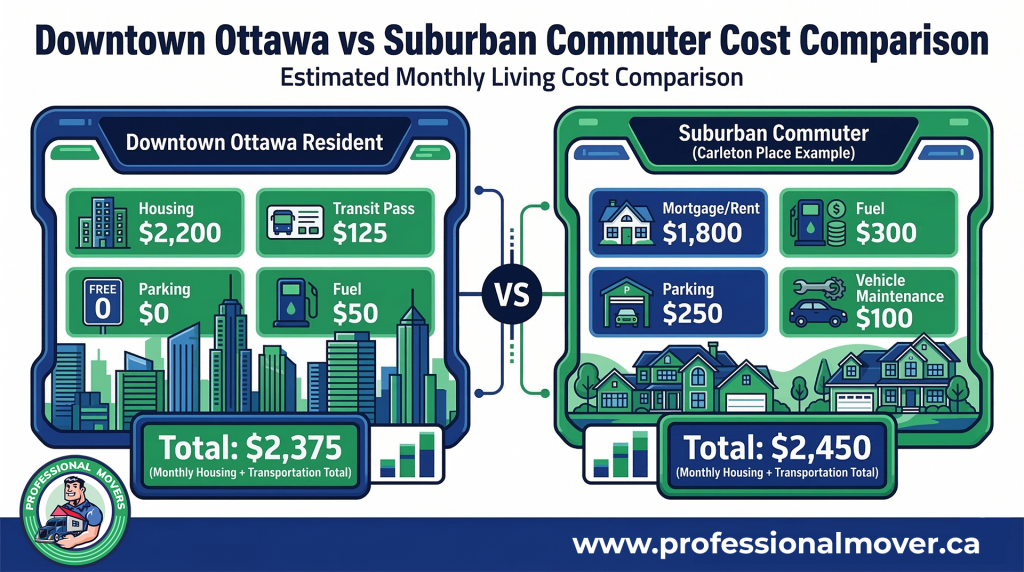
The financial impact of commuting to downtown Ottawa can be substantial. Typical monthly commuting costs may include:
- Fuel: $250–$350
- Downtown parking: $200–$350
- Vehicle maintenance: $80–$120
- OC Transpo transit pass: $120+
Estimated total monthly commuting cost: $400–$700+
This level of driving significantly increases fuel consumption and vehicle wear.
Expenses associated with long-distance commuting include:
- gasoline costs
- oil changes
- tire replacements
- vehicle depreciation
- increased maintenance intervals
Drivers also face unpredictable fuel prices, which can make monthly commuting expenses fluctuate.
Key Insight: Is Living in Ottawa Suburbs Really Cheaper?
Living outside the city can reduce housing costs, but the cost of living in Ottawa’s suburbs often increases due to commuting expenses, higher vehicle usage, and rural home maintenance. Residents commuting from towns like Carleton Place, Arnprior, or Rockland may spend hundreds of dollars each month on fuel, parking, and vehicle maintenance.
When these costs are combined with longer commute times and property upkeep, suburban living may not always be significantly cheaper than living closer to downtown Ottawa.
Downtown Ottawa Parking Costs for Suburban Commuters
For commuters who drive into the city, parking costs in downtown Ottawa can become a substantial monthly expense.
Parking rates in central business districts frequently range between:
- $200 to $350 per month
This cost is rarely included in initial housing comparisons but can dramatically increase the real cost of commuting.
OC Transpo vs Driving: Which Is Cheaper for Suburban Commuters?
Some suburban commuters rely on OC Transpo, Ottawa’s public transportation system, which operates bus routes and the O-Train.
A typical OC Transpo monthly pass costs over $120.
Residents living farther from the city centre often combine driving with transit, using Park and Ride stations before continuing by train or bus to reach downtown Ottawa.
This mixed commute can add significantly to monthly transportation expenses, including fuel, parking, and vehicle maintenance.
According to Statistics Canada, transportation has become one of the fastest-growing household costs in Canadian metropolitan areas, especially for residents living outside urban cores.
As a result, commuting from the suburbs can quickly diminish the apparent savings of lower housing prices.
Key Takeaway: There’s no one-size-fits-all solution. OC Transpo may reduce commuting costs for some, but many suburban residents combine transit with driving, adding fuel, parking, and maintenance expenses. For many, these commuting costs can diminish the savings from lower housing prices.
Property Taxes in Ottawa vs Nearby Suburban Municipalities
Property taxes are another factor that can influence the cost of living in Ottawa suburbs and commuter towns. Tax rates vary between municipalities.
As a result, residents living outside the City of Ottawa, in areas such as Lanark County or Prescott and Russell United Counties, may encounter different tax structures.
In some cases, property taxes outside the city may be lower. However, those lower rates can also reflect differences in municipal services.

Residents living within the City of Ottawa often benefit from services such as:
- municipal snow removal
- waste collection programs
- maintained public roads
- access to public transit networks
- urban infrastructure maintenance
In rural areas or smaller municipalities, residents may need to arrange some of these services privately.
Over time, these additional responsibilities can increase overall living costs, even when property tax rates appear lower.
Does a Longer Commute from Ottawa Suburbs Increase Your Auto Insurance Costs?
Commuting distance can also affect another important household expense: car insurance.
Insurance providers often calculate premiums based on several factors, including:
- annual driving distance
- commuting frequency
- exposure to traffic and accident risk
When a daily commute adds 50 to 60 kilometres or more, yearly mileage increases significantly.
Higher mileage can lead to increased insurance premiums for some drivers.
Over time, the combination of insurance adjustments, vehicle maintenance, and fuel expenses can make living in Ottawa suburbs and commuting to work more costly than many households initially expect.
Hidden Maintenance Costs of Living in Ottawa’s Suburbs and Rural Areas
Living in suburban or rural communities outside Ottawa often means transitioning away from fully serviced urban infrastructure.
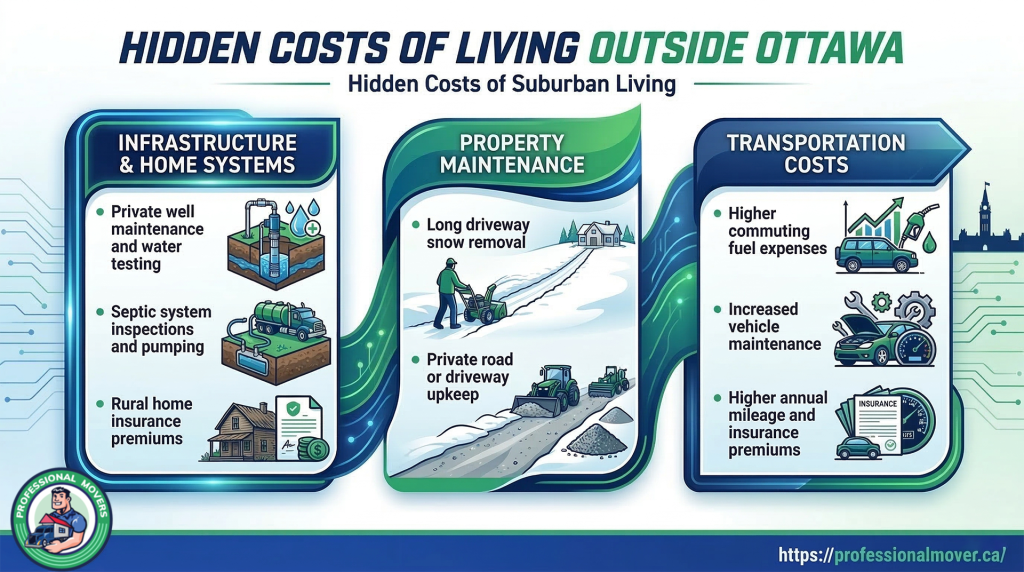
Many homes in outer communities rely on systems that city residents rarely have to manage. These can include:
- private wells for water supply
- septic systems
- long private driveways
- limited municipal snow clearing
Understanding these differences is important because they can introduce additional maintenance responsibilities for homeowners.
Well Water Maintenance
Homes that rely on private wells require regular water testing to ensure safe drinking water.
Well systems and pumps also need occasional maintenance, and repairs may be required over time.
Septic System Maintenance
Septic systems require periodic inspections and pumping to remain effective.
While they can function reliably for many years, they still require ongoing maintenance that homeowners in fully serviced urban areas typically do not have to perform.
Snow Removal and Property Access
In rural areas with long driveways or private roads, snow removal often becomes the homeowner’s responsibility during the winter months.
Many residents choose to hire private snow-clearing services to maintain safe access to their property during heavy snowfall.
These additional responsibilities can contribute to the hidden costs of living in Ottawa suburbs and commuter towns, particularly for households moving from fully serviced urban neighbourhoods.
How Commuting from Ottawa Suburbs Impacts Your Time and Lifestyle
Beyond direct financial costs, commuting also affects how people spend their time each day.
Research on transportation patterns across Canadian cities shows that long commute times can significantly influence lifestyle and work–life balance.
For someone commuting 45 to 60 minutes each way, the yearly time commitment quickly adds up. A one-hour commute in each direction equals:
- 10 hours per week spent travelling
- approximately 500 hours per year
- more than 20 full days annually spent commuting
This is time that could otherwise be spent with family, resting after work, or participating in daily activities.
Traffic conditions can make commuting even more unpredictable.
Major routes such as Highway 417, one of the busiest transportation corridors in the Ottawa region, frequently experience congestion during peak travel hours.
Longer commute times can affect several aspects of daily life, including:
- Childcare schedules
- Family time in the evenings
- Stress levels during the workweek
- Overall work–life balance
For residents in Ottawa’s suburban communities, these lifestyle considerations are just as important as financial costs when evaluating how far from work to live.
The True Financial Impact of Living Far From Work in Ottawa
Living farther from work affects more than just your daily commute; it also has ongoing financial implications. Longer travel distances increase fuel consumption, vehicle wear, and commuting time, adding to the overall cost of living farther from downtown Ottawa.
Other factors that contribute to higher expenses include:
- Navigating rural roads, long driveways, or narrow access routes
- Maintaining a larger home with more belongings, which can require extra vehicle use or equipment
- Coordinating errands, school runs, and other daily tasks over longer distances
Even if a home farther from the city offers more space or lower housing costs, additional travel and daily logistical considerations can reduce the apparent savings.
For households living in Ottawa’s suburban or commuter communities, the overall financial impact can be significant.
These costs can quickly offset the apparent savings from lower housing prices found closer to the urban core.
Is It Actually Cheaper to Live Outside Ottawa?
The answer often depends on each household’s priorities and daily routine.
For some families, suburban living still offers meaningful advantages, including:
- larger homes
- quieter neighbourhoods
- more outdoor space
- family-friendly communities
However, when evaluating the cost of living in Ottawa suburbs, it’s important to consider the complete financial picture.
Expenses such as commuting costs, vehicle maintenance, insurance, property upkeep, and time spent travelling can significantly influence overall affordability.
The lowest home price does not always mean the lowest cost of living.
For households in the Ottawa region, the long-term affordability of a location depends on more than just housing costs.
A practical choice balances home prices, commute times, and everyday living expenses.
Final Thoughts: The Cheapest House in Ottawa Suburbs Isn’t Always the Lowest-Cost Lifestyle
Living outside Ottawa can offer attractive housing opportunities and lifestyle benefits.
However, choosing to live farther from work involves more than simply comparing home prices.
Transportation costs, commuting time, property maintenance responsibilities, and differences in municipal services can all influence the true cost of living far from work in the Ottawa region.
For many households planning a move, the ideal location often lies somewhere between affordability and convenience.
Choosing the right place to live often means balancing commute time, housing costs, and lifestyle priorities.
As discussed earlier, our detailed guide to Ottawa’s suburbs and commuter towns compares communities across the region to help you find the one that best fits your needs.
Common Questions on Commuting, Housing, and Expenses in Ottawa Suburbs
Is it cheaper to live outside Ottawa?
Living outside Ottawa can reduce housing costs, especially in commuter towns like Carleton Place, Arnprior, or Rockland. However, when commuting expenses, vehicle maintenance, and property upkeep are included, the overall cost difference may be smaller than expected.
What is the average commute time from Ottawa suburbs?
The average commute time from Ottawa suburbs ranges from 35 to 60 minutes each way, depending on distance and traffic conditions. Major routes such as Highway 417 can experience congestion during peak hours, especially for commuters travelling toward downtown Ottawa.
What hidden costs should homeowners consider when moving to rural areas near Ottawa?
Some of the hidden costs of suburban or rural living include septic system maintenance, well-water testing, private snow removal, longer commuting distances, and higher vehicle use. These expenses can add to the overall cost of living outside the city.
Testimonials

Hardworking, focussed and polite. What surprised me was their care and attention detail, almost as if they were moving their own possessions. Thank you for your incredible service.
Contact Us

How It Works
Quality services and
the highest level of professionalism

Contact our team
Reach out to Professional Movers Ottawa via phone or e-mail


Get a free estimate
Consult with our agents on additional services you may need


Organize your move with ease
Let us guide you through a smooth moving process
