

Get Your Free Estimate Now
"*" indicates required fields









If you’re searching for a home in Ottawa right now, you’re probably stuck between two options: a modern downtown condo or a townhouse with more space in the suburbs.
At first glance, the choice feels simple: condos look cheaper, while townhouses seem expensive. But once you start digging deeper, the decision between an Ottawa condo vs. a townhouse in 2026 gets confusing fast.
Monthly condo fees, maintenance costs, space, location, and long-term value all start pulling you in different directions.
Many buyers rush into this decision and later realize they chose based on price rather than on how they actually want to live. The truth is, both options come with trade-offs that aren’t obvious upfront.
This guide breaks down the real costs, lifestyle differences, and long-term value so you can choose with clarity and avoid an expensive mistake later.
Ottawa Condo vs Townhouse Prices in 2026: Real Market Numbers

In Ottawa, the price gap between condos and townhouses is clear, but it needs proper context. As of 2026, most apartment-style condos are selling in the $376K–$426K range, while freehold townhouses are typically between $562K–$586K. That’s a price gap of roughly $180K–$210K, depending on the property type and location.
Looking at real transactions makes this easier to understand. A small one-bedroom condo can still be found for around $239K, usually in older buildings or less central pockets. On the other end, a newer three-bedroom townhouse in suburban areas like Barrhaven or Orleans can sell for around $624K, depending on age, layout, and upgrades.
This gap exists mainly because of land ownership and space. With a condo, you’re buying the unit itself, not the land. A townhouse includes land, multiple levels, and more usable square footage, which directly increases its value.
In practice, condos attract first-time buyers or investors looking for a lower entry point. Townhouses are more common for move-up buyers who need space and are willing to pay for it.
Monthly Cost Breakdown: Condo vs Townhouse Ottawa
While the purchase price sets the stage, the monthly carrying cost defines your reality. In Ottawa, your budget isn’t just about the mortgage; it’s a balance of four key pillars: Mortgage, Property Tax, Fees, and Utilities.
April 2026 Financial Context: These calculations are based on the Bank of Canada’s policy rate of 2.25%. While the 5-year fixed rate hovers around 4.94%, well-qualified buyers with high down payments may see rates closer to ~4.5%–4.7% in the current market.
Using our 2026 benchmarks (Condos at $376K–$426K vs. Townhouses at $562K–$586K), here is how the numbers actually hit your wallet:
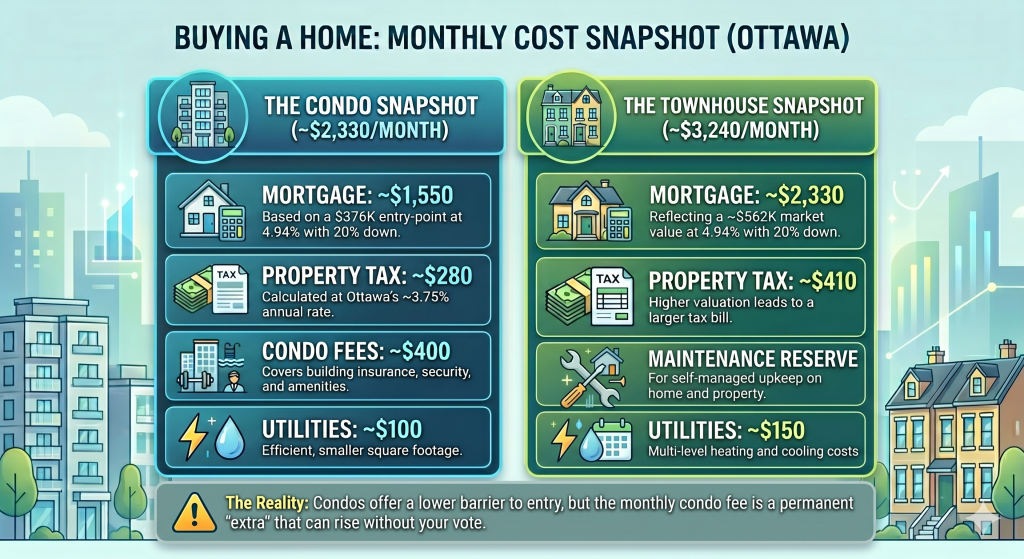
The Reality: You pay a premium of roughly $910 more per month for the townhouse, but you trade monthly fees for long-term land equity.
What this actually means: A condo is about predictable, hands-off living. A townhouse is an investment in space and autonomy. In 2026, the “best” choice depends on whether you prefer a leaner monthly commitment or more room to grow in the suburban belt.
Why Condos Aren’t Always Cheaper: Ottawa Condo Fees Explained
In Ottawa, a condo might have a lower mortgage, but the Monthly Condo Fee is the great equalizer. While these fees usually range from ~$400 to $900, they aren’t just “lost money.” They cover shared costs like building insurance, snow removal, and water.
However, the real risk isn’t the monthly fee, it’s the Special Assessment. If the building’s reserve fund is low and the roof fails, every owner receives a bill for their share of the repair costs.
Expert Tip: The Status Certificate
Before you waive conditions, your lawyer must review the Status Certificate. This document tells you if the condo corporation is in a legal battle or if a massive fee hike is coming. In 2026, a healthy reserve fund is the best insurance policy for your investment.
Freehold Townhouse Costs: The Hidden Expenses Nobody Talks About
The biggest draw of a freehold townhouse is the $0 monthly fee. While this feels like a win for your cash flow, it shifts 100% of the liability onto your shoulders. When you own the land and the structure, you are the property manager.
The Reality of Maintenance:
Unlike a condo, where costs are managed by a board, a townhouse owner needs to self-fund a “private reserve.”
The Surprise Factor: A furnace failure or a roof leak during an Ottawa winter can easily result in an overnight $5,000–$10,000 repair bill.
The Long Game: Over 10 years, you might spend the same amount on a townhouse roof and driveway as you would on condo fees, but the townhouse costs are “lumpy”, meaning they hit all at once.
Key Insight: “No fees” simply means you have the autonomy to choose when and how to spend your maintenance budget. Just make sure that money is sitting in a high-interest savings account before the snow starts falling.
Condo vs Townhouse Lifestyle: Which One Actually Fits You?
In Ottawa, choosing between these two isn’t just a financial play, it’s about how you want to spend your Saturdays and how much “homeowner homework” you’re willing to do.
The Condo Lifestyle:
Ideal for busy professionals and investors who value a “lock-and-leave” setup. If you want zero responsibility for shoveling snow or fixing a roof, the condo is your best bet. You sacrifice a backyard for proximity to the LRT and downtown lifestyle hubs.
The Townhouse Lifestyle: Designed for families and space seekers. If you need a private yard for the kids or a multi-level layout to separate your home office from your living room, a townhouse is the standard.
The “Real-Life” Tie-Breakers:
Pets and Parking: Townhouses offer direct backyard access and private garages. Condos mean elevator rides for every bathroom break and usually one assigned underground spot.
The Verdict: If you want autonomy and a garden, buy the townhouse. If you want a predictable schedule and a gym in your building, stick with the condo.
Best Areas in Ottawa for Condos vs Townhouses (Where Each Makes Sense)
In Ottawa, the neighbourhood you choose usually dictates what kind of home you can find. Here is a simple breakdown of where each option makes the most sense in 2026:
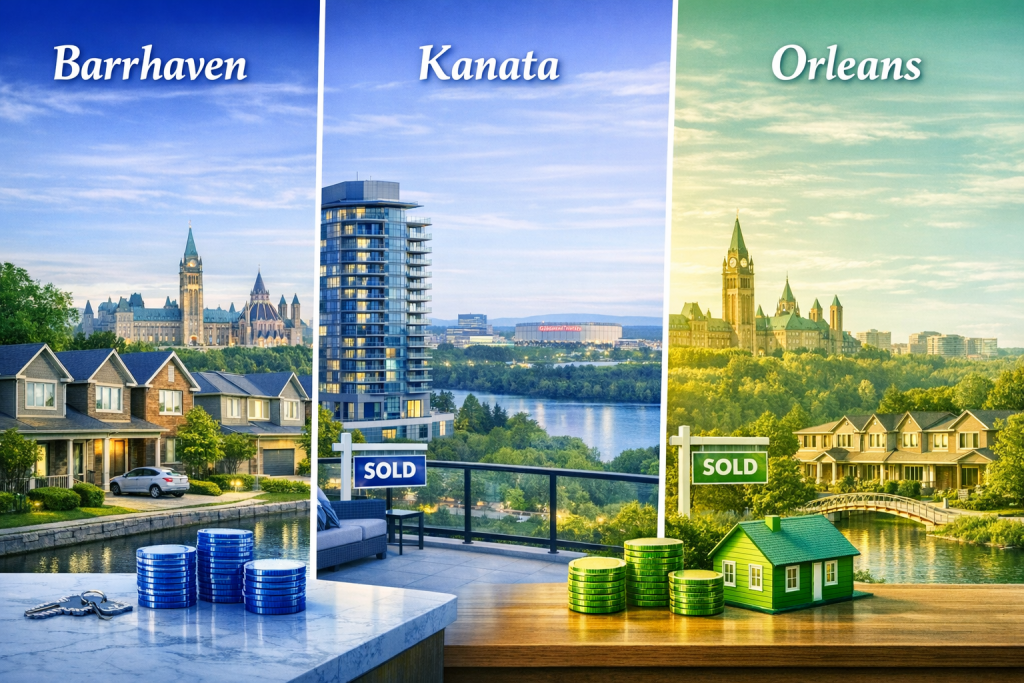
The Condo Zones: Downtown, Westboro, and the ByWard Market
Why here: These areas are “high-density,” meaning buildings go up instead of out. Because land is expensive, condos are often the only way to live in these spots without a million-dollar budget.
The Connection: These neighbourhoods sit right on the O-Train (our light-rail train system). This is perfect for people who work in government or tech and want to skip the nightmare of downtown parking. You aren’t just buying a unit; you’re buying a shorter commute and a walk to the grocery store.
The Townhouse Zones: Barrhaven, Kanata, and Orleans
Why here: These are the “suburbs,” where there is more room to build outward. In Kanata and Barrhaven, townhouses are the most common choice because they offer a middle ground, cheaper than a detached house but bigger than a condo.
The Connection: These areas are designed for families. You’ll find more parks, schools, and “Power Centers” (large clusters of shops like Walmart and Home Depot) nearby. It’s the go-to for buyers who need a private garage and a backyard for a dog or a BBQ.
The Verdict: If your life revolves around the train and walking, stick to the Urban Core (Downtown/Westboro). If you need more square footage and a private driveway for your car, look toward the Suburban Belt (Kanata/Barrhaven/Orleans).
Condo vs Townhouse Investment: Which is the Best Property to Buy in Ottawa 2026?
From a purely financial perspective, the freehold Ottawa townhouse market has historically outperformed the condo.
The reason is simple: Land Ownership.
When you buy a freehold property, you own the plot it sits on, a finite resource in land-locked suburban pockets like Kanata or Barrhaven.
Expert Note on Land Ownership: You might hear that “all land in Canada belongs to the Crown.” While technically true in a constitutional sense, as a Freehold owner, you hold what’s called ‘Fee Simple’ title. This is the highest form of private ownership in Canada, giving you exclusive rights to the land and its long-term appreciation.
The Appreciation Gap
Townhouses generally see higher resale demand because they appeal to a wider demographic, from young families to downsizers. This “family utility” creates a supply-demand imbalance; while a developer can add 200 units to the skyline with one condo tower, they can only build so many townhouses on a single street.
When Condos Take the Lead
However, condos can outperform townhouses in “Prime Urban Pockets.” A well-managed building in Westboro or the Glebe holds its value through scarcity and location. While we have seen some Ottawa condo decline 2026 trends in older or poorly managed buildings, premium units offer a lower entry point. Making them a more accessible “stepping stone” for first-time buyers looking to stop paying rent and start building equity for their next move.
Investment Verdict:
If your goal is maximum capital growth and you can handle the higher upfront cost, buy a townhouse. If you want a stable, low-maintenance entry into the market with high rental demand, a centrally located condo is the smarter strategic play.
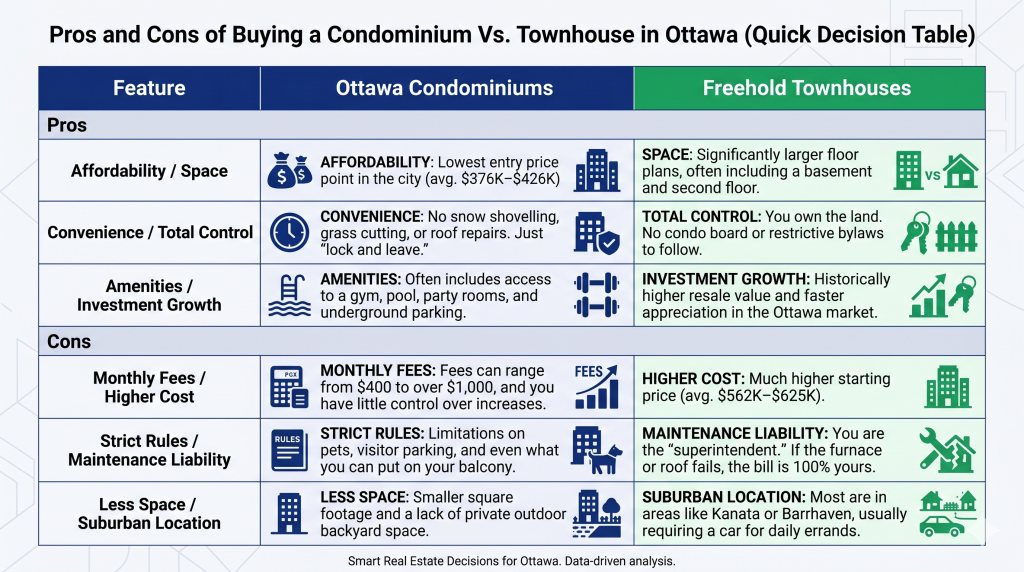
Pros and Cons of Buying a Condominium Vs. Townhouse in Ottawa (Quick Decision Table)
Whether You Choose a Condominium or a Townhouse, Professional Movers Ottawa Supports Every Move
No matter what you decide in the Ottawa condo vs townhouse 2026 debate, the move itself comes with very different challenges. Condo relocations often involve strict elevator booking windows, limited loading zones, and building bylaws that restrict moving hours. In contrast, townhouse moves deal with narrow staircases, multiple levels, and tighter suburban streets that complicate truck access and furniture handling.
At Professional Movers Ottawa, we plan around these realities. For example, during a recent downtown condominium move-in in Westboro, our team coordinated elevator timing, secured padding for common areas, and completed the move within a 3-hour window without delays. In a separate Barrhaven townhouse move, we handled a three-level home, carefully navigating stairs and disassembling large furniture for safe transport.
From packing to final placement, our approach is structured, efficient, and tailored to the property type, ensuring your move stays on schedule without unnecessary complications.
Should You Buy a Condo or Townhouse in Ottawa?
Choosing between a “glass house in the sky” and a “front door with stairs” comes down to one question: Do you want to manage your life or your real estate?
If your 2026 goal is a “lock and leave” lifestyle near the LRT in Westboro or the Glebe, an apartment condo wins. You trade the “fee simple” control for zero-maintenance living and high-end amenities like gyms and rooftop terraces.
If you’re a growing family or just done with $700+ monthly fees you can’t control, then a freehold townhouse in Kanata or Barrhaven is your smartest strategic play. You get the yard, the basement storage, and the long-term wealth that only land ownership provides.
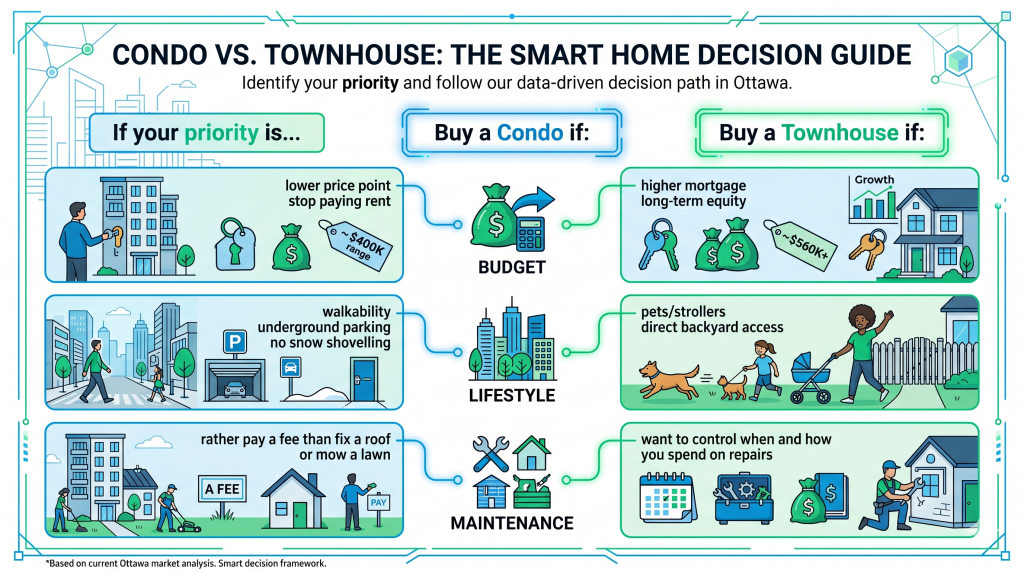
Quick Decision Framework
Common Questions Buyers Ask About Condos and Townhouses
What is the monthly expense of owning a condo in Ottawa?
In 2026, most condo owners in Ottawa spend roughly $2,300 to $2,600 per month. This typically includes mortgage, property taxes, condo fees, and basic utilities, depending on the building and location.
What exactly is a condo townhouse in Ottawa?
A condo townhouse is a hybrid property. You get a multi-level home similar to a townhouse, but exterior maintenance like roofing, snow removal, and landscaping is handled by a condo corporation through monthly fees. Some townhouses are ‘Freehold with a common elements fee’ (POTL), usually for private road snow removal.
Are condo townhouses a good investment in Ottawa?
They can be a practical middle-ground investment. While they may not be as highly appreciated as freehold townhouses, they offer more space than condos and lower maintenance responsibilities, which keeps them in steady demand.
Between condos and townhouses, which is better to live in Canada?
If you’re relying on transit and want zero maintenance, condos win. If you need space or have a family, townhouses make more sense.
How do rent prices compare between condos and townhouses in Ottawa?
In Ottawa, condos typically rent in the $2,200–$2,600 range, while townhouses can vary widely from about $2,600 up to $7,500 depending on size, location, and whether the property is newer or upgraded.

Testimonials

Hardworking, focussed and polite. What surprised me was their care and attention detail, almost as if they were moving their own possessions. Thank you for your incredible service.
Contact Us

How It Works
Quality Services and
the Highest Level of Professionalism

Contact our team
Reach out to Professional Movers Ottawa via phone or e-mail


Get a free estimate
Consult with our agents on additional services you may need


Organize your move with ease
Let us guide you through a smooth moving process
